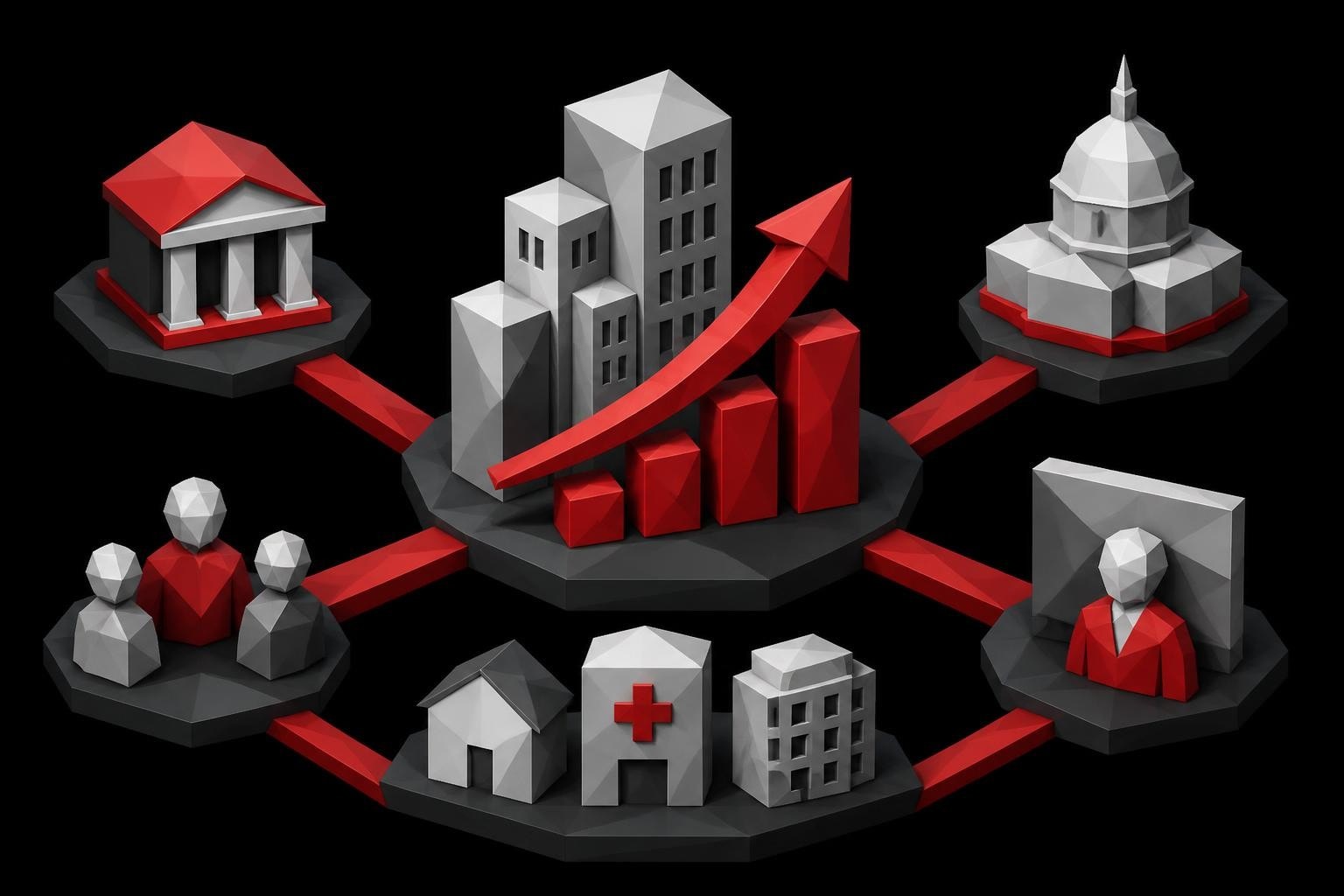
The business world is evolving at a pace never seen before, with leaders facing new challenges and opportunities every day. Staying ahead of the curve will be crucial for those who want to thrive in the landscape of 2026 business trends.
This article reveals the eight most influential 2026 business trends shaping the future. From artificial intelligence and automation to sustainability, data security, and flexible work, these trends will redefine how organizations operate and compete.
Expect actionable insights and practical strategies to help you lead your business confidently through disruption. Ready to future-proof your organization? Let us explore the trends shaping tomorrow’s success.
The Macro Forces Driving 2026 Business Trends
The landscape of 2026 business trends is shaped by powerful macro forces that influence every industry. Understanding these drivers is essential for leaders who want to anticipate change and position their organizations for success.

Global Economic Shifts and Market Volatility
2026 business trends are deeply influenced by global economic changes. Inflation and fluctuating interest rates are reshaping consumer demand, pushing organizations to rethink pricing and investment strategies. Disruptions in global supply chains have highlighted the need for agility, prompting many companies to diversify sourcing and build resilience.
Emerging markets are expected to play a pivotal role in global growth, with recent projections indicating a rebound in world GDP by 2026. According to a Bank of America survey, small and mid-sized businesses in the U.S. anticipate stronger revenue and operational expansion in 2026.
| Factor | Impact on Business |
|---|---|
| Inflation | Increased costs, pricing |
| Interest rates | Investment, borrowing |
| Supply chain | Diversification, agility |
| Emerging markets | Growth opportunities |
Companies that adapt by managing risk and exploring new markets will thrive as 2026 business trends evolve.
Regulatory and Policy Changes
Regulatory shifts are another major force driving 2026 business trends. New rules on data privacy, labor standards, and sustainability are raising the bar for compliance. The 2025 tax bill and updated reporting requirements are adding complexity, especially for organizations with cross-border operations.
Small businesses are adjusting quickly, adopting new policies to comply with minimum wage laws and sustainability mandates. Leaders must stay informed and proactive to navigate the evolving regulatory environment.
For companies aiming to succeed, integrating regulatory awareness into strategic planning is becoming a core part of 2026 business trends.
Technological Acceleration
Rapid technological progress is redefining 2026 business trends across sectors. The adoption of AI, automation, and digital platforms is streamlining operations and boosting productivity. Low-code and no-code tools are enabling more teams to innovate without deep technical expertise.
These advancements are also transforming workforce roles, requiring new skills and approaches to talent management. Many small and medium businesses are leveraging AI-assisted recruiting and workflow tools to stay competitive.
Embracing technology is not just an option, but a necessity for organizations looking to capitalize on 2026 business trends.
Changing Workforce Dynamics
Workforce expectations are evolving, and this shift is central to 2026 business trends. Remote and hybrid models are now the norm, giving employees greater flexibility. Organizations are placing a stronger emphasis on well-being, mental health, and work-life balance.
Attracting and retaining talent in a tight labor market means offering flexible benefits and upskilling opportunities. Companies that prioritize employee experience will be better positioned to navigate the talent challenges shaping 2026 business trends.
A proactive approach to workforce dynamics ensures resilience and adaptability in a rapidly changing environment.
8 Key 2026 Business Trends Shaping the Future
The landscape for 2026 business trends is rapidly evolving, demanding that leaders anticipate change and act decisively. This year, eight pivotal trends will define the future of business, influencing everything from technology adoption to workforce strategy. Understanding these trends is crucial for any organization looking to thrive amid ongoing disruption.

1. Artificial Intelligence and Automation at Scale
Artificial intelligence is no longer a distant vision; it is a core driver among 2026 business trends. Organizations are integrating AI into decision-making, customer service, and operations to unlock new efficiencies.
Process automation is transforming repetitive tasks, freeing teams to focus on higher-value work. In recruitment, AI-powered tools streamline candidate matching and reduce bias. For example, Salesforce’s AI CRM personalizes sales outreach, while Paychex’s AI-assisted recruiting delivers faster, smarter hiring.
The impact on job roles is significant. Companies must invest in reskilling and workforce planning to harness AI’s benefits while addressing ethical considerations. Over 70% of small and midsize businesses plan to increase AI investment by 2026, reflecting the urgency of this trend.
To stay ahead, leaders should evaluate best AI tools to invest in that align with their business goals. Balancing efficiency with transparency builds trust both internally and with customers.
As AI becomes ubiquitous, navigating the opportunities and risks will define success across 2026 business trends.
2. Personalized Customer Experience and Hyper-Targeted Marketing
Customer expectations are rising, and 2026 business trends demand businesses deliver individualized experiences. Data analytics and AI enable brands to craft highly personalized journeys, from product recommendations to tailored messaging.
Omnichannel strategies now integrate digital and physical touchpoints for seamless service. Loyalty programs are evolving, using advanced customer journey mapping to boost retention and lifetime value.
For example, leading e-commerce brands leverage AI for real-time personalization, offering the right product at the right moment. This approach is not just effective; it is expected—80% of consumers anticipate tailored interactions by 2026.
However, achieving true personalization requires balancing innovation with privacy. With stricter regulations on data use, companies must prioritize transparency and compliance.
To excel in this area, businesses should invest in tools that unify customer data and enable hyper-targeted campaigns. The ability to deliver personalized value while respecting customer boundaries is a hallmark of top-performing organizations in the 2026 business trends landscape.
3. Sustainability and ESG Commitments as Core Strategy
Sustainability is moving from a peripheral concern to a central pillar of 2026 business trends. Environmental, Social, and Governance (ESG) factors now serve as competitive differentiators, driving both regulatory compliance and consumer loyalty.
Regulatory bodies are increasing pressure on companies to reduce their environmental impact and report transparently. At the same time, 65% of global consumers prefer eco-friendly brands, making sustainability a direct driver of revenue.
Organizations are investing in green technologies, carbon reduction initiatives, and net zero policies. Transparent ESG reporting is becoming standard, with stakeholders demanding accountability.
Small businesses, in particular, can seize opportunities in the green economy by offering sustainable products and services. The shift toward ESG also opens doors for innovation, such as circular business models and renewable energy integration.
Embracing ESG is not just about compliance; it is about future-proofing the business and aligning with the values of customers and investors. In 2026 business trends, sustainability is synonymous with long-term success.
4. Flexible Work Models and the Evolving Employee Value Proposition
Flexibility is reshaping the workplace, and it stands out among 2026 business trends. Remote, hybrid, and asynchronous work models are now standard, offering employees greater autonomy and work-life balance.
The demand for flexible benefits, mental health support, and diversity, equity, and inclusion (DEI) initiatives is surging. Businesses that prioritize these areas attract and retain top talent, even in a tight labor market.
Technology is enabling distributed teams to collaborate seamlessly. Platforms like Slack and cloud-based solutions foster agility and cohesion, regardless of location.
For instance, companies redesigning roles for flexibility have seen improvements in engagement and productivity. In fact, 60% of businesses are now restructuring job descriptions to enhance adaptability.
Building a strong culture in a dispersed environment requires intentional efforts, such as regular check-ins and clear accountability frameworks. Organizations that embrace flexibility as a core value will be better positioned to respond to market shifts and employee needs as part of 2026 business trends.
5. Data Security, Privacy, and Compliance
As digital transformation accelerates, data security has become a cornerstone of 2026 business trends. The threat landscape is expanding, with cyber incidents affecting 45% of small and midsize businesses in 2025.
Organizations must comply with evolving data privacy laws, including GDPR and CCPA, to avoid costly penalties and reputational damage. Investments in cybersecurity tools and employee training are essential to protect sensitive information.
Secure cloud platforms and proactive risk management strategies are now standard practice. Companies are adopting multi-layered defenses, from encryption to real-time threat detection.
Balancing innovation with risk mitigation is critical. While new technologies drive growth, they also introduce vulnerabilities that require vigilant oversight.
In the context of 2026 business trends, robust data governance is not optional—it is a prerequisite for growth and customer trust. Businesses that prioritize security and privacy will stand out in an increasingly complex digital environment.
6. Financial Agility and New Funding Models
Adaptability in finance is a defining aspect of 2026 business trends. Economic uncertainty demands that organizations manage cash flow meticulously and build financial resilience.
The rise of alternative funding options, such as crowdfunding, revenue-based financing, and fintech solutions, is empowering businesses to diversify capital sources. Digital payment and expense management tools streamline operations and enhance visibility.
Strategic cost optimization and scenario planning are essential for navigating volatile markets. Companies that regularly assess their financial health can pivot quickly when conditions change.
For example, 55% of businesses plan to explore new funding channels in 2026. This proactive approach reduces dependence on traditional lenders and fosters innovation.
Agile financial strategies enable organizations to seize growth opportunities and weather downturns. Leaders who prioritize financial flexibility will thrive as 2026 business trends reshape the competitive landscape.
7. Digital Transformation for Small and Midsize Businesses
Digital transformation is a top priority in 2026 business trends, especially for small and midsize businesses (SMBs). The acceleration of cloud adoption, SaaS platforms, and integrated business tools is leveling the playing field.
Automation of HR, payroll, and operations is driving efficiency and cost savings. Low-code and no-code solutions democratize technology, enabling non-technical teams to innovate rapidly.
Providers like Paychex and Salesforce are offering scalable digital solutions tailored to SMB needs. These platforms help businesses streamline processes, improve customer experiences, and boost agility.
A recent survey shows that 75% of SMBs rank digital transformation as a critical objective for 2026. However, overcoming barriers such as budget constraints and change management remains a challenge.
Maximizing return on investment requires a clear strategy, regular training, and a commitment to continuous improvement. SMBs that embrace digital transformation as part of their 2026 business trends agenda will gain a lasting competitive advantage.
8. Globalization, Localization, and Market Expansion
Globalization remains a significant force within 2026 business trends, but the approach has evolved. Companies are leveraging digital channels to enter new markets while maintaining local relevance and compliance.
Cross-border e-commerce is booming, and international hiring is on the rise. Businesses are adopting global HR and payroll solutions to manage diverse teams and regulatory requirements.
Balancing global reach with personalized customer experiences is crucial. Localized marketing, product adaptation, and compliance strategies help organizations connect with regional audiences.
Statistics reveal that 40% of SMBs are planning international expansion by 2026. Success in new markets hinges on understanding cultural nuances and regulatory landscapes.
Scaling globally while preserving customer intimacy requires operational agility and robust technology infrastructure. Organizations that master both globalization and localization will be leaders in the next wave of 2026 business trends.
Practical Strategies for Adapting to 2026 Business Trends
Adapting to 2026 business trends requires more than awareness—it demands a strategic, proactive approach. Leaders must prepare their organizations to be resilient, innovative, and agile to navigate the evolving landscape.

Building a Future-Ready Organization
Fostering a culture of continuous learning is essential for staying ahead with 2026 business trends. Encourage teams to embrace innovation, experiment with new ideas, and adapt quickly to change.
Investing in leadership development and upskilling ensures employees have the skills needed for tomorrow’s challenges. Progressive companies now offer unlimited training programs and mentorship opportunities to build resilient workforces.
Leaders who empower their people to learn, collaborate, and innovate position their businesses for long-term success. For inspiration on actionable steps, explore these small business ideas for 2026 that align with future-ready strategies.
Leveraging Technology for Competitive Advantage
Identifying and adopting the right digital tools is vital to capitalize on 2026 business trends. Cloud-based platforms, AI, and automation can streamline operations and provide real-time insights for smarter decisions.
Consider integrating low-code or no-code solutions to boost agility and accelerate digital transformation. Businesses that embrace data analytics and automation gain a measurable edge in efficiency and customer experience.
By leveraging technology, organizations can scale rapidly and adapt to market shifts. Staying current with digital innovation is now a core part of maintaining competitive advantage.
Navigating Change with Agility and Accountability
To thrive amid 2026 business trends, organizations must develop agile processes that can respond quickly to disruption. Implementing rapid feedback loops, scenario planning, and cross-functional teams helps ensure flexibility.
Set clear KPIs and accountability structures to drive execution. Use real-time metrics to monitor progress and make course corrections as needed. This proactive mindset keeps teams aligned and motivated.
Building agility and accountability into your culture enables businesses to navigate uncertainty confidently and turn challenges into opportunities for growth.