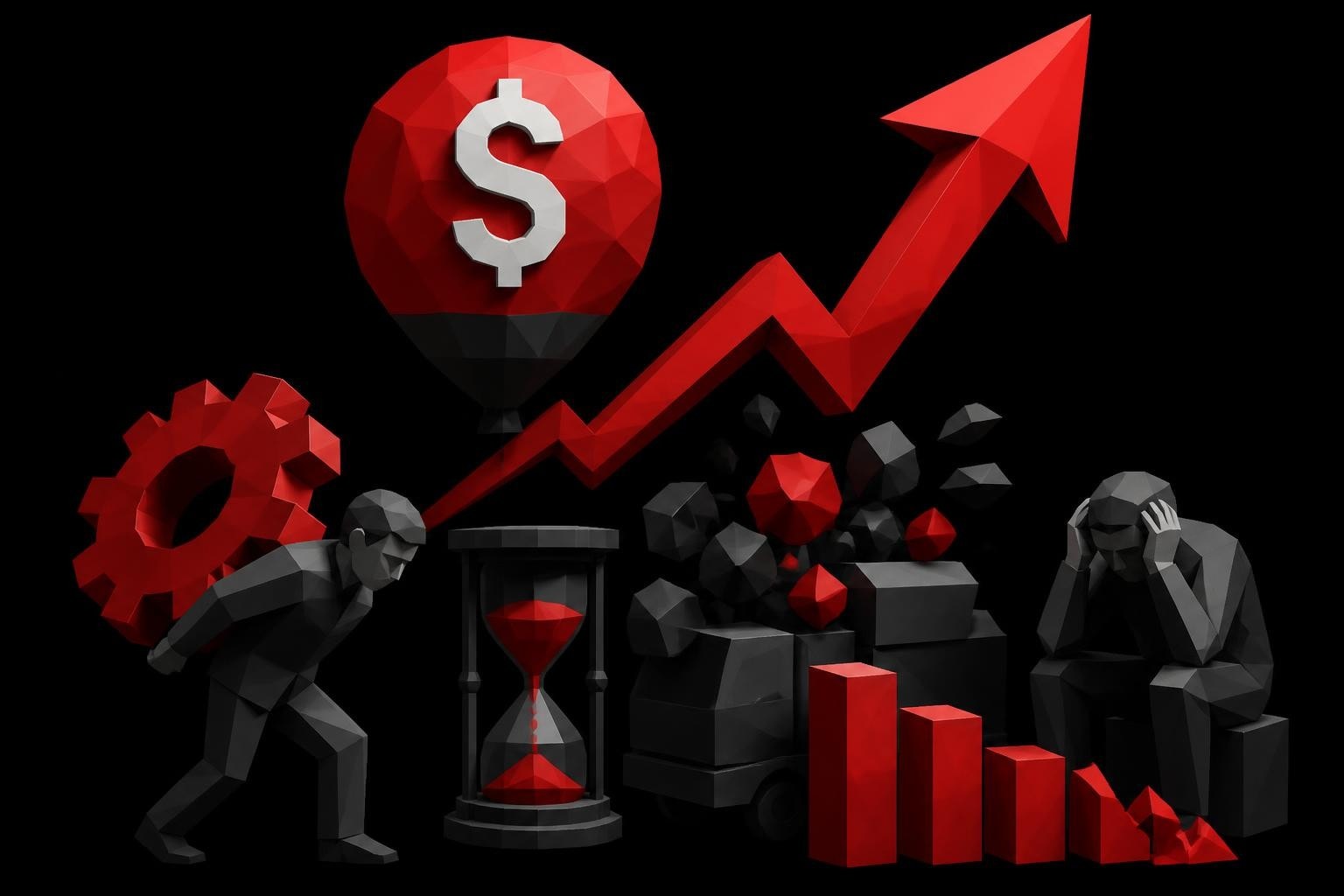
I’ve watched hundreds of businesses die in the past eighteen months. Not because they lacked customers. Not because their product sucked. They died because they ran out of cash while chasing growth metrics that meant nothing when the bills came due. The pattern is so predictable now that I can spot a dying business three months out just by looking at their cash position versus their growth targets. Cash flow beats growth in 2026, and if you’re still optimizing for revenue expansion over liquidity, you’re playing a game that ends badly.
Why Most Business Owners Get This Wrong
The coaching industry sold you a lie. Grow at all costs. Scale fast. Raise prices and expand. Hire aggressively. The problem? That advice worked in 2019 when money was cheap and customers were spending. It doesn’t work now.
I’ve seen optometry practices add three locations in twelve months and file bankruptcy eighteen months later. HVAC companies that doubled their team and couldn’t make payroll by winter. Financial advisors who bought expensive CRM systems and marketing funnels while their operating account dropped below $10,000.
The fundamental error is simple: they optimized for revenue growth instead of cash generation.
Revenue is a vanity metric. It tells you what you invoiced. Cash tells you what you can spend, what you can save, and whether you’ll survive the next downturn. Cash flow quality provides a clearer financial picture than revenue growth, revealing risks that impressive sales figures hide completely.
The 2026 Reality Check
Let me give you the numbers that matter. Three clients came to us in Q1 2026 with the same problem:
- Client A: $840K revenue, negative $12K monthly cash flow
- Client B: $620K revenue, positive $18K monthly cash flow
- Client C: $1.1M revenue, negative $31K monthly cash flow
Guess which two are still in business today? Client B thrives. Clients A and C are in crisis mode, cutting staff and begging for lines of credit they won’t get.
The difference wasn’t their market. It wasn’t their sales skills. It was their fundamental understanding that cash flow beats growth in 2026, and no amount of top-line revenue saves you when you’re bleeding cash monthly.

What Changed Between 2019 and 2026
Everything costs more. Your customers pay slower. Your vendors want payment faster. The economic cushion that let you play loose with cash management is gone.
Here’s what actually shifted:
Interest rates went from near-zero to 6-8% on business lines of credit. That cheap money you used to cover gaps? It costs real money now. Most small businesses can’t afford to borrow their way out of cash crunches anymore.
Customer payment cycles extended. What used to be Net 30 is now Net 45 or Net 60 in practice. B2B clients especially are protecting their own cash, which means you’re financing their operations with your working capital.
Operating costs increased 20-40% across most categories. Payroll, insurance, rent, materials, software subscriptions. Everything went up, but most business owners didn’t adjust their pricing fast enough or cut expenses hard enough to compensate.
| Metric | 2019 Reality | 2026 Reality | Impact |
|---|---|---|---|
| Average Payment Cycle | 32 days | 51 days | 59% slower |
| Cost of Capital | 2-4% | 6-9% | 150% increase |
| Operating Expense Growth | Baseline | +28% average | Margin compression |
| Customer Acquisition Cost | Stable | +45% average | Profitability pressure |
The businesses that survived figured this out early. Strong cash flow strategy enables confident expansion even during economic uncertainty, but only when you build the foundation first.
The Working Capital Trap
Most growth kills businesses through working capital drain. You land a big contract. Great. Now you need to buy materials, pay people, and cover overhead for 60-90 days before the client pays you.
Growth often consumes cash through working capital demands, creating a cycle where success creates cash crises. I’ve watched this pattern destroy profitable businesses repeatedly.
A roofing contractor we worked with landed a $180K commercial project. Sounds amazing, right? Here’s what actually happened:
- Month 1: Spent $52K on materials and deposits
- Month 2: Spent $71K on labor and equipment rental
- Month 3: Spent $28K finishing the job
- Month 4: Client paid $90K (first draw)
- Month 5: Client paid remaining $90K
Total profit: $29K. Sounds good. But for four months, he was $151K in the hole. His operating account dropped to $3,800. He nearly lost his truck to repossession. He couldn’t bid other jobs because he had no cash to start them.
That’s how growth kills you. Cash flow beats growth in 2026 because survival requires liquidity, not contracts you can’t afford to fulfill.
The Accountability Now Framework for Cash Priority
We built a system that most coaches won’t teach you because it requires saying no to opportunities. It requires cutting things that feel productive. It requires being honest about what you can actually afford.
Step One: Calculate Your Real Cash Position
Not your bank balance. Your actual available cash after accounting for:
- Committed expenses in the next 30 days
- Payroll obligations
- Vendor payments due
- Tax obligations (most owners forget quarterly taxes)
- Debt service
- Owner draw requirements
Your real cash position is what’s left after those obligations. For most businesses, it’s 40-60% lower than their bank balance suggests.
We make clients track this weekly. Every Monday, you know your real number. Not the fantasy number. The amount you can actually deploy without creating a crisis.
Step Two: Implement the 3-Month Rule
You don’t take growth opportunities unless you can fund them for three full months without customer payment. Period.
This eliminates 60-70% of “opportunities” immediately. Good. Most of those opportunities would have killed your business. The ones that remain are actually fundable, which means you can execute them successfully and collect payment without going under.
Step Three: Ruthlessly Cut Non-Revenue Activities
Most businesses are doing thirty things that generate zero cash. Networking events. Elaborate marketing campaigns. Committee memberships. Industry associations. Fancy CRM buildouts they’ll never fully use.
We audit every activity and ask one question: Does this generate cash within 90 days?
If no, it gets cut or deferred until cash position improves. This isn’t about being short-sighted. It’s about surviving long enough to actually benefit from long-term investments.
A financial advisor we worked with was spending $2,100 monthly on a podcast, $800 on a business coach who gave generic advice, and $450 on lead generation software she never opened. We cut all three. Her cash flow improved $3,350 monthly. That’s $40,200 annually. She invested half of that into direct client acquisition activities that actually generated revenue.

Why Revenue Growth Became Dangerous
The advice you’ve heard for years is backwards now. “You can’t cut your way to growth.” “You have to invest in your business.” “Spend money to make money.”
All true in the right context. All deadly in 2026 if you don’t have cash reserves.
The Failed Growth Playbook
Here’s what the typical business coach tells you:
- Hire before you need to
- Invest in systems and software
- Increase marketing spend to drive leads
- Raise prices but maintain service levels
- Expand your service offerings
- Open new locations or territories
Sounds great. Except every single item on that list consumes cash before it generates cash. And in 2026, CFO priorities center on mastering liquidity and building resilience against macroeconomic volatility, not aggressive expansion.
I’ve worked with businesses that followed this playbook perfectly and failed spectacularly. A mental health group practice hired four therapists in six months. Added an office manager. Upgraded their EHR system. Launched Google Ads. Revenue grew 43% year-over-year.
They closed sixteen months later with $87K in debt and negative equity.
What happened? Insurance reimbursements came in 60-90 days. Payroll went out every two weeks. The new therapists took 4-6 months to fill their caseloads. The office manager was necessary but didn’t generate revenue. The EHR system cost $14K upfront plus $800 monthly. Google Ads burned $2,400 monthly with mediocre conversion.
Growth consumed every dollar they generated plus another $5K-$8K monthly from the owner’s personal savings.
The Working Alternative
Cash flow beats growth in 2026 because the winners are playing a different game entirely. They’re optimizing for:
- Cash conversion speed: How fast can we turn work into collected payment?
- Operating leverage: How much revenue can we generate without adding fixed costs?
- Margin preservation: Are we making enough per transaction to actually keep cash after expenses?
Here’s the tactical breakdown:
Optimize collections before sales. Most businesses focus on landing new clients. Winners focus on getting paid faster by existing clients. We helped an HVAC company cut their average collection time from 47 days to 23 days just by implementing deposit requirements, progress billing, and automated payment reminders. Same revenue. Twice the cash flow.
Eliminate low-margin work ruthlessly. That client who pays slowly, complains constantly, and barely covers your costs? Fire them. I know it feels wrong. Do it anyway. We had a contractor cut his three lowest-margin clients (18% of revenue) and his monthly cash flow improved because he stopped funding their jobs with his working capital.
Increase prices on existing work before adding new services. New services require investment, training, marketing, and time to profitability. Price increases on current services are pure margin expansion with zero additional cost. We helped a bookkeeping firm raise prices 15% across their client base. They lost two clients out of thirty-seven. Net impact: $31K additional annual profit that went straight to cash reserves.
The Operational Fixes That Actually Matter
Most operational advice is theoretical garbage. “Build better systems.” “Document your processes.” “Create SOPs for everything.”
Fine. But none of that fixes cash flow problems this quarter. Here’s what actually works:
Aggressive Receivables Management
You’re not a bank. Stop acting like one. If your terms are Net 30, you should have money by day 35 maximum. Here’s the collection sequence we implement:
- Day 1: Invoice sent with payment link (not PDF attachment)
- Day 7: Automated friendly reminder
- Day 14: Personal email or text from owner
- Day 21: Phone call with specific payment commitment
- Day 30: Final notice with late fees applied
- Day 35: Stop all work, implement collections process
Sounds aggressive? Good. Your vendors aren’t giving you 60-day float. Your landlord doesn’t accept “I’ll pay when my clients pay me.” Why are you extending that courtesy to customers who are using your cash as free financing?
We implemented this with a general contractor. His average collection time dropped from 52 days to 28 days. His cash position improved $43K in the first quarter. Same clients. Same work. Just actual enforcement of payment terms.
Inventory and Supply Management
If you carry inventory or materials, you’re bleeding cash. Every dollar sitting in your shop or warehouse is a dollar that’s not available for payroll, growth, or emergencies.
Just-in-time ordering beats bulk discounts. Yes, you save 8% buying in volume. You also tie up $15K in cash that sits on shelves for six months. Unless you’re turning that inventory in under 30 days, the bulk discount costs you money through opportunity cost and cash unavailability.
We worked with an electrician who kept $22K in commonly used materials “just in case.” We cut that to $6K of fast-moving items and implemented supplier accounts with 2-day delivery. He freed up $16K in cash immediately. His material costs went up about $1,800 annually. Net benefit: $14,200 in available cash that he used to eliminate his line of credit balance and stop paying $890 in monthly interest.
Payroll Optimization
This is where most owners screw up the worst. They hire for potential future needs instead of current revenue capacity.
The rule: Your total payroll (including owner draw and payroll taxes) should never exceed 40% of collected revenue. Not invoiced revenue. Collected revenue. The money you actually have.
If you’re running 50-60% payroll to revenue, you’re one slow month away from crisis. If you’re over 60%, you’re already in crisis and lying to yourself about it.
| Payroll % | Business Health | Action Required |
|---|---|---|
| Under 35% | Excellent position | Consider strategic hiring |
| 35-40% | Healthy range | Monitor closely |
| 41-50% | Warning zone | Freeze hiring, increase prices |
| 51-60% | Danger zone | Cut staff or increase revenue 20%+ |
| Over 60% | Crisis mode | Immediate restructuring needed |
We helped a therapy practice that was running 64% payroll to collected revenue. They had seven therapists and an admin. We cut to five therapists (both departures were voluntary through managed attrition) and had the owner cover admin tasks temporarily. Payroll dropped to 43% of revenue. Cash flow went from negative $4,200 monthly to positive $6,800 monthly. Three months later, they hired back an admin at a lower cost point. The business survived because they acted before the crisis became fatal.

The Strategic Shift: Cash Flow Beats Growth in 2026
The fundamental reframe is this: growth is a byproduct of healthy operations, not a goal you chase at the expense of survival.
What Winners Do Differently
The businesses thriving in 2026 made hard choices early. They said no to opportunities others chased. They cut expenses that felt important. They stayed small longer than felt comfortable.
Case study: We worked with a CPA firm that had the opportunity to acquire a retiring accountant’s book of business. Forty-three clients, $180K in annual billings, offered at $90K (half of annual revenue, which is standard).
The owner wanted it badly. His competitors would have jumped immediately. Here’s why we advised against it:
- He’d need to borrow $90K (his cash reserves were only $34K)
- Interest costs: $6,300 annually
- Client retention risk: typically 30-40% leave during transitions
- Integration time: 6-9 months of reduced productivity
- Training needs: his team wasn’t equipped to handle the specialized work
- Cash flow timing: those clients paid 45-60 days out, extending his collection cycle
Instead, we helped him raise prices 12% on existing clients (added $47K annually), fire his two lowest-margin clients (freed up 8 hours weekly), and focus that time on higher-margin tax planning services (added $28K annually).
Net result: $75K in additional profit without borrowing money, extending his cash cycle, or risking client retention. His cash reserves grew to $73K within ten months. Now he’s in position to acquire a practice if the right opportunity comes along, and he can fund it with cash instead of debt.
That’s the difference. Cash flow beats growth in 2026 because it creates options. Debt and cash crunches eliminate options.
Building Cash Reserves Systematically
You need six months of operating expenses in reserve. Minimum. Most business owners have six days. Here’s the system:
Step 1: Calculate your monthly operating expense. Everything. Payroll, rent, insurance, subscriptions, debt service, utilities, supplies. Average it over the past six months.
Step 2: Set your target. Six months of that number. If your monthly operating expense is $38K, your target is $228K in reserves.
Step 3: Automate the accumulation. Every dollar that comes in gets split: 70% to operating account, 30% to reserves. Non-negotiable. You adjust spending to fit the 70%, not steal from the 30%.
Step 4: Never touch reserves except for emergencies. And no, “a great opportunity” is not an emergency. Emergencies are: can’t make payroll, essential equipment broke, sudden loss of major client, health crisis.
We implemented this with a plumbing company in March 2026. They started with $8,200 in reserves and $41K monthly operating expenses. They committed to the 30% split. By December, they had $87K in reserves. They turned down a $140K commercial job they couldn’t fund. They said no to hiring two plumbers who wanted to join. They skipped a trade show that cost $4,500.
When their primary van died in November ($12K replacement cost), they paid cash. When their biggest client (22% of revenue) went bankrupt in January 2027, they had four months of runway to replace that revenue. The business survived because they prioritized cash over growth for ten consecutive months.
Measuring What Actually Matters
Most businesses track the wrong metrics. Revenue. Gross profit. Number of clients. None of that tells you if you’re going to survive the next six months.
The Five Cash Flow Metrics That Matter
Operating Cash Flow (OCF): Cash from business operations after all expenses. This is your most important number. If it’s negative, you’re dying. If it’s positive but small, you’re fragile. If it’s positive and growing, you’re healthy.
Calculate it monthly: Cash collected from customers minus cash paid for expenses. Not accrual accounting. Actual cash in and out.
Cash Conversion Cycle (CCC): How long between spending cash on operations and collecting cash from customers. Lower is better. We aim for under 30 days. Over 60 days is dangerous.
Formula: Days inventory outstanding + Days sales outstanding – Days payables outstanding
Burn Rate: How fast you consume cash when revenue stops. Critical for service businesses especially. If you lost every client today, how long until you run out of money?
Calculate: Monthly operating expenses divided by current cash reserves. Expressed in months. Under 3 months is crisis. Over 6 months is healthy.
Cash Flow Margin: Operating cash flow divided by revenue. Shows how much of your revenue actually becomes cash you can use. We target 15% minimum. Under 10% means you’re working for nothing. Under 5% means you should probably quit and get a job.
Days Cash on Hand: Current cash divided by average daily operating expenses. Another way to measure runway. We want 180+ days. Under 30 days means you’re gambling with survival.
| Metric | Crisis Level | Warning Level | Healthy Level | Excellent Level |
|---|---|---|---|---|
| OCF Margin | Negative | 0-5% | 10-15% | 20%+ |
| Cash Conversion | 90+ days | 60-89 days | 30-59 days | Under 30 days |
| Days Cash on Hand | Under 15 | 15-45 | 45-120 | 180+ |
| Burn Rate Coverage | Under 1 month | 1-3 months | 3-6 months | 6+ months |
Track these weekly. Not monthly. Weekly. Every Monday, you should know exactly where you stand on all five metrics. When any metric moves into warning territory, you take immediate action. You don’t wait. You don’t hope it improves. You cut expenses, increase collections effort, or defer growth plans.
The Things You Need to Stop Doing
Most advice tells you what to do. I’m telling you what to stop doing because that’s how you fix cash flow problems fast.
Stop hiring before you need to. The “hire ahead of growth” advice is deadly now. You hire when you have consistent cash flow that supports the additional payroll for six months minimum. Not when you’re busy. Not when you hope to be busy. When you have cash.
Stop carrying clients who pay slowly. If someone consistently pays outside your terms, they’re stealing from you. Either they pay on time going forward, pay a premium for extended terms, or they’re gone. No exceptions. Your loyalty to bad clients is killing your business.
Stop investing in “future growth” initiatives when you can’t fund current operations comfortably. That new CRM, the rebrand, the additional certification, the marketing campaign. All nice-to-haves when you have cash reserves. All business-killers when you’re operating on thin margins.
Stop accepting scope creep without pricing adjustments. Every extra request, every additional revision, every “small favor” costs you time and money. If it’s outside the original scope, it gets priced and paid for. Period.
Stop competing on price. You cannot out-discount competitors who have better cash positions. You’ll go broke winning price wars. Compete on value, speed, specialization, or expertise. Never on price when you have cash flow problems.
Real World Results From Prioritizing Cash
Let me give you outcomes from businesses that made the shift in 2025 and 2026.
Optometry Practice: Dr. Stevens ran his practice at $780K revenue with negative monthly cash flow averaging $3,200. He had 60-day patient payment cycles through insurance, carried $45K in frame inventory, and employed three optical assistants plus an office manager.
Changes implemented:
- Required 50% payment at service for all private pay patients
- Negotiated faster reimbursement with top three insurance carriers
- Cut frame inventory to fast-moving styles only (freed up $28K cash)
- Eliminated one assistant position through attrition
- Raised exam fees 18%
Results after 9 months:
- Revenue dropped slightly to $761K (lost some price-sensitive patients)
- Monthly cash flow improved to positive $11,400
- Built cash reserves from $4,100 to $67,200
- Eliminated line of credit balance ($31K paid off)
- Owner stress decreased dramatically (his words: “I sleep now”)
HVAC Company: Martinez Heating & Air did $1.2M in revenue with erratic cash flow, occasional payroll misses, and constant stress. Owner was working 70-hour weeks and taking home less than his senior techs.
Changes implemented:
- Implemented 50% deposits on all jobs over $2,500
- Moved to progress billing on larger commercial work
- Stopped bidding jobs under $500 (not profitable after drive time)
- Raised prices 22% across the board
- Cut marketing spend from $3,800 to $800 monthly (stopped TV ads, kept Google)
Results after 11 months:
- Revenue dropped to $1.04M (lost price shoppers, didn’t replace low-margin small jobs)
- Monthly cash flow improved from averaging $2,100 to $18,700
- Owner draw increased from $78K annually to $127K
- Work weeks dropped to 45-50 hours
- Business sold for $890K (2024 comparable: wouldn’t have been saleable)
Financial Advisory Practice: Susan ran a fee-only planning practice at $420K revenue with inconsistent cash flow because clients paid quarterly or annually, creating massive swings.
Changes implemented:
- Moved all clients to monthly billing (same annual amount, better cash timing)
- Eliminated all clients under $3,600 annual fees (freed up 30% of her time)
- Raised minimums for new clients to $6,000 annually
- Stopped attending three conferences annually (saved $8,400 plus time)
- Hired a part-time admin at $2,100/month instead of full-time at $4,800
Results after 8 months:
- Revenue increased slightly to $447K (fewer clients, higher fees)
- Monthly cash flow smoothed from swings of $-8K to $+31K to consistent $14K-$18K monthly
- Client service quality improved (more time per client)
- Cash reserves built from $11K to $94K
- Work-life balance improved dramatically
These aren’t special cases. They’re normal business owners who stopped chasing growth and started managing cash. The pattern is identical across every success story: sacrifice some revenue growth to achieve cash flow stability, and the business becomes dramatically healthier.
The 2026 Economic Reality Nobody Wants to Say
We’re likely heading into a contraction. Maybe a recession. Maybe just a prolonged slowdown. The signals are everywhere.
Customer spending is slowing. B2B buying cycles are extending. Consumers are more price-sensitive. Decision-makers are more conservative.
Access to capital is restricted. Banks aren’t lending to small businesses like they did three years ago. Lines of credit are harder to get and more expensive when you do.
Operating costs aren’t coming down. Inflation may be “controlled” but prices aren’t dropping back to 2019 levels. Your new normal is 25-35% higher costs on everything.
In this environment, cash flow beats growth in 2026 because survival is the only strategy that matters. You can’t grow your way out of a recession. You can’t scale through a contraction. You survive by being lean, liquid, and ruthlessly focused on cash generation.
The businesses that fail will be the ones that kept playing the 2019 playbook. Aggressive hiring. Debt-funded expansion. Revenue growth at any cost. They’ll look successful right up until they shut down.
The businesses that survive will be boring. Profitable. Cash-rich. Unglamorous. They’ll turn down opportunities. They’ll stay smaller than they could be. They’ll say no more than yes.
And they’ll be standing when the dust settles, positioned to acquire the assets of failed competitors for pennies on the dollar.
The shift from growth obsession to cash flow discipline isn’t just smart strategy for 2026, it’s survival. We’ve seen too many capable business owners destroy their companies chasing revenue targets while ignoring liquidity, and we’re done watching it happen. If you’re ready to fix your cash flow problems with real systems, honest accountability, and tactical execution that actually works, Accountability Now helps business owners implement these exact frameworks without the guru nonsense or long-term contracts.