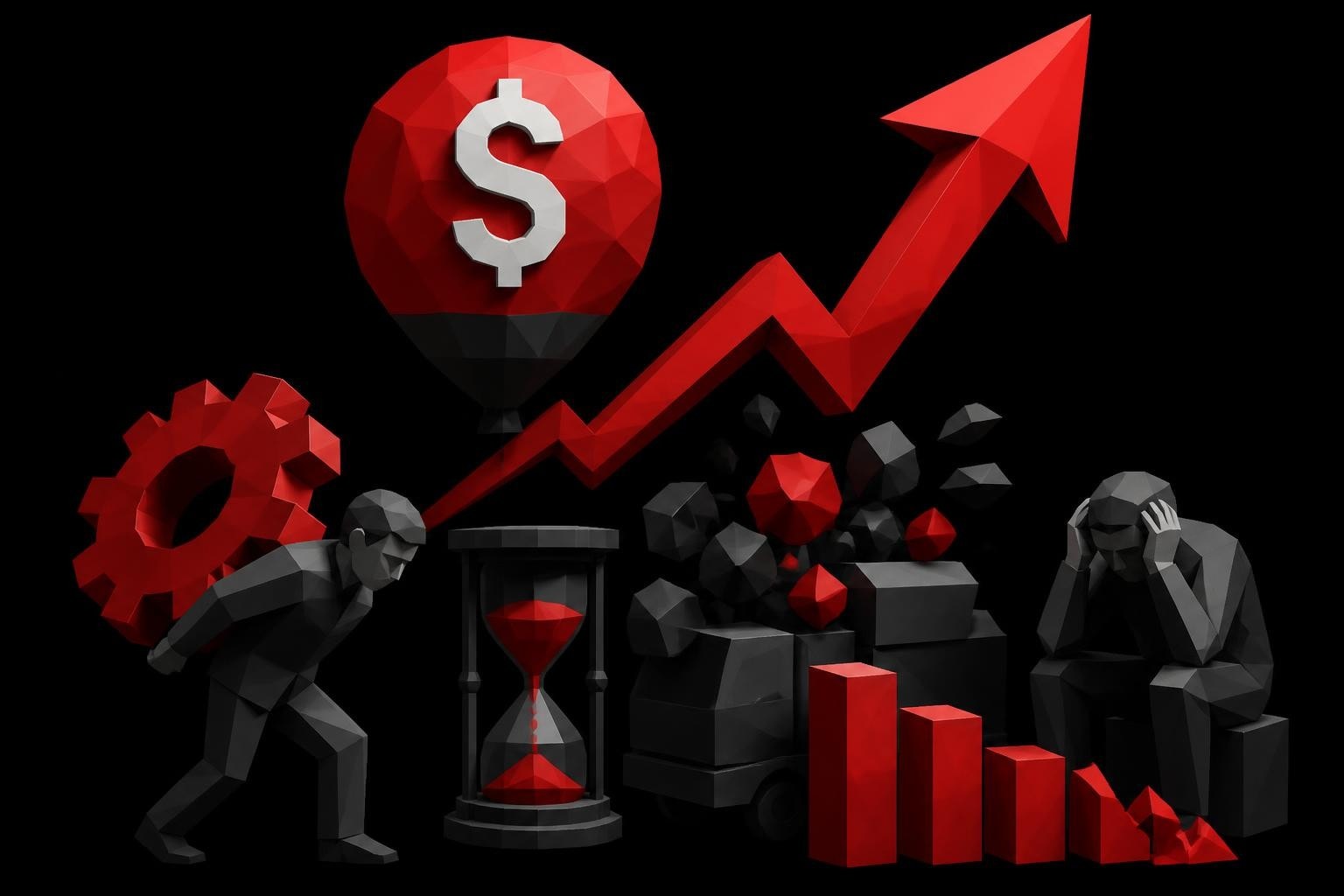
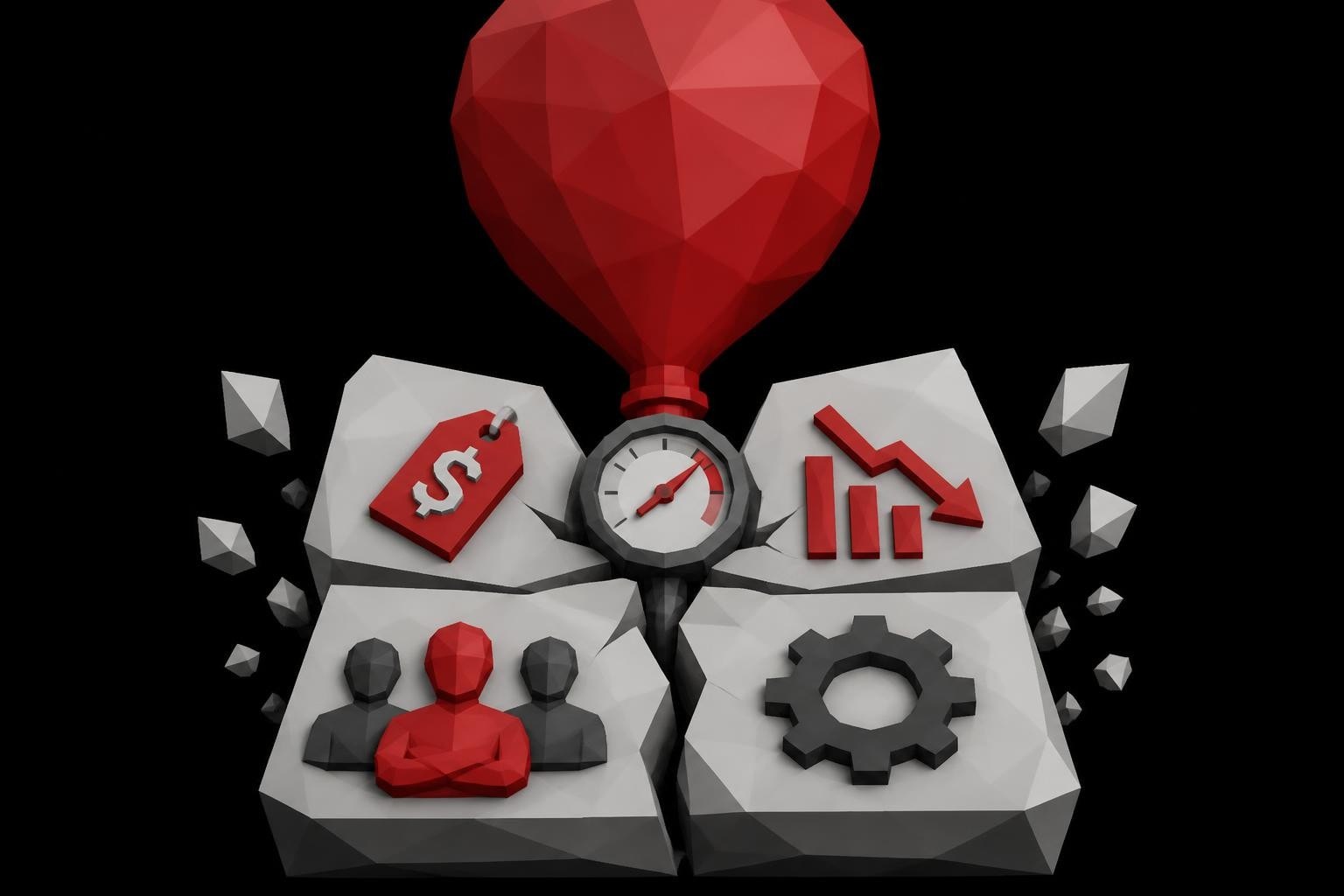
Tariffs don't break your business. They expose what was already broken. The 2025-2026 tariff wave didn't create operational chaos in small businesses. It revealed which owners had functional systems and which ones were running their companies on hope, sticky notes, and a prayer. The businesses that got crushed weren't victims of bad policy. They were victims of their own operational negligence. When costs spike 15-30% overnight and suppliers disappear, you learn real fast whether your systems can handle reality or if you've been coasting on good times. Tariffs expose weak business systems because weak systems can't absorb shocks, can't pivot quickly, and can't give owners the visibility they need to make decisions that matter.
The Brutal Reality of System Weakness Under Tariff Pressure
Most small business owners don't know what they're buying, from whom, or at what real cost until a tariff hits. That's not a tariff problem. That's a systems problem.
I've watched home service companies with $2M in annual revenue discover they couldn't tell me where their materials were coming from. One HVAC contractor learned in March 2025 that 60% of his equipment components were Chinese-manufactured after his distributor hit him with a 25% price increase. He had no backup suppliers. No alternative sourcing strategy. No purchase order system that flagged country of origin. He was flying blind.
When tariffs expose weak business systems, they reveal these specific failures:
- No supplier diversification or vendor scorecards
- Zero visibility into component sourcing and manufacturing origins
- Manual purchase order processes with no tracking systems
- Cash flow forecasting that's three months behind reality
- Inventory management based on gut feel instead of data
- No contract terms protecting against sudden cost escalations
The businesses that survived weren't smarter about tariffs. They had better systems before tariffs became a crisis.

The Procurement Blind Spot That Kills Margins
Procurement isn't sexy. It's not sales. It's not marketing. It's boring spreadsheet work that most owners delegate to whoever complains least about doing it. That's exactly why tariffs have evolved into a systemic risk that threatens entire supply chains.
A medical practice owner I worked with in 2025 was getting optical equipment from three different vendors. She thought she had diversification. She didn't. All three vendors sourced from the same Chinese manufacturer. When tariffs hit, all three raised prices simultaneously. Her "system" was actually a single point of failure disguised as three purchase orders.
Here's what weak procurement looks like in practice:
| Weak System | Strong System |
|---|---|
| Vendor selected by price alone | Vendor scorecard: price, reliability, origin, alternatives |
| No documentation of sourcing origins | Country-of-origin tracked in purchase system |
| Annual negotiations only | Quarterly reviews with contingency clauses |
| Single-source dependencies hidden in relationships | Forced dual sourcing for critical components |
| No tariff impact modeling | Scenario planning for 10%, 25%, 50% cost increases |
The strong systems exist. Most owners just never built them because they didn't have to. Until they did.
Cash Flow Forecasting Fails Under Economic Pressure
Tariffs expose weak business systems fastest through cash flow. A 20% cost increase on materials doesn't show up in your P&L immediately. It shows up in your bank account when you can't make payroll because you didn't forecast the cash impact three months out.
I've seen this destroy profitable businesses. A roofing contractor in Texas was booking $150K months consistently in 2024. Margins looked fine. His accountant said he was profitable. Then material costs spiked 18% in Q1 2025 due to steel tariffs. His prices were locked on signed contracts. His cash flow model was "check the bank balance on Fridays." He burned through his cash reserves in 47 days.
The cash flow systems that failed:
- Backward-looking P&L reviews instead of forward cash projections
- No rolling 13-week cash forecast
- Project costing based on old material prices
- No automatic price escalation clauses in contracts
- Zero buffer for cost volatility
The businesses that survived had boring, unsexy systems. Weekly cash forecasting. Contract terms allowing price adjustments for material cost changes above 10%. Three-month cash reserves minimum. These weren't tariff strategies. These were basic operational disciplines that protected against any economic shock.
Why "Profitable" Doesn't Mean Protected
Profitability and cash flow are not the same thing. This is basic finance. Yet most small business owners manage their companies like they are.
Research shows tariffs have disrupted up to 40% of supply chain activity in 2025, affecting not just costs but demand patterns and sourcing strategies. Your P&L might show profit while your cash account is bleeding out because of timing mismatches between when you pay inflated material costs and when customers pay you.
A financial services firm I worked with learned this the hard way. They were helping clients with tax planning but their own systems were a disaster. When office equipment costs jumped due to electronics tariffs, they faced a choice: eat the cost or pass it through. They passed it through. Clients delayed purchases. Revenue timing shifted by 60 days. Their cash forecast, which was really just "last month's revenue minus last month's expenses," didn't catch the gap until they were $40K short on a quarterly tax payment.
The Supplier Relationship Illusion
Most business owners think they have supplier relationships. They don't. They have transactional dependencies with friendly phone calls.
Real supplier relationships survive stress. Tariffs expose weak business systems by revealing which "partnerships" were actually just convenient arrangements that collapse under the first bit of pressure.
Here's what I've observed across dozens of businesses in 2025-2026:
Businesses that thought they had supplier relationships discovered:
- Their "partnership" meant nothing when costs spiked
- No communication system existed for crisis scenarios
- Suppliers prioritized larger customers instantly
- Alternative sourcing took 4-6 months to establish
- No service level agreements protected delivery timelines
One electrical contractor lost his primary supplier relationship when tariffs hit because his "relationship" was actually just two decades of placing orders with the same rep. The rep retired in January 2025. The new account manager had 300 accounts and zero loyalty to some guy who never formalized contract terms, never built relationships with management, and never structured his purchasing to get priority treatment.

The Real Cost of Manual Processes
Tariffs expose weak business systems most brutally in businesses running on manual processes. When you need to reprice 40 services, source alternative suppliers for 15 product categories, and reforecast cash flow weekly, manual spreadsheets kill you.
A mental health practice owner spent 60 hours in March 2025 manually updating her pricing model after medical supply costs increased. Sixty hours. She wasn't seeing clients. She wasn't managing her team. She was updating Excel because she never built an automated pricing system tied to cost inputs.
| Manual Process | System-Based Process | Time Difference |
|---|---|---|
| Update pricing in 6 different spreadsheets | Change base cost in one system, prices auto-update | 12 hours vs. 15 minutes |
| Email 8 suppliers for quotes manually | Automated RFQ through procurement system | 4 hours vs. 20 minutes |
| Recalculate project margins one by one | Batch recalculation with cost change scenarios | 8 hours vs. 30 minutes |
| Update client proposals individually | Template system pulls current pricing automatically | 6 hours vs. immediate |
The time cost is real. But the decision cost is worse. While you're buried in manual updates, your competitors with better systems are already repricing, communicating with clients, and closing new business.
Political and Economic Volatility Demands System Resilience
The 2025-2026 tariff environment isn't an anomaly. It's the new normal. U.S. Presidential Report has documented how trade policy has become more unpredictable across administrations, with sudden policy shifts creating ongoing business uncertainty. Whether tariffs continue, expand, or get replaced with different trade restrictions, economic volatility is here to stay.
Tariffs expose weak business systems because weak systems can only operate in stable environments. The businesses that failed in 2025 weren't killed by tariffs specifically. They were killed by their inability to adapt to any significant change.
I watched this play out in real time. One plumbing company had the same suppliers, same pricing model, same operational playbook for eight years. The owner was proud of his consistency. Then tariffs hit brass fittings and PVC pipe. His entire cost structure shifted. He had no system for rapid pricing updates, no relationships with alternative suppliers, no cash reserves for transitional costs. Consistency became rigidity. Rigidity became failure.
What Adaptive Systems Actually Look Like
Adaptive systems aren't complicated. They're disciplined. The businesses that handled tariffs well had these specific capabilities:
- Quarterly scenario planning: Not annual budgets, quarterly reviews with 3-5 cost scenarios modeled
- Dual sourcing requirements: Policy requiring two qualified suppliers for any critical component
- Automated price monitoring: Systems tracking supplier price changes weekly, flagging increases above 5%
- Contract flexibility clauses: Terms allowing price adjustments tied to documented cost increases
- Rolling cash forecasts: 13-week minimum, updated weekly, reviewed with management
- Cross-functional crisis protocols: Documented processes for rapid decision-making when conditions change
None of this requires enterprise software or huge teams. A $2M home services company can run these systems with basic tools and discipline. Most just don't.
The Inventory Management Nightmare
Tariffs expose weak business systems viciously through inventory. When costs are rising, do you stock up? Cut back? How much? For how long? If you don't have an inventory management system with real data, you're gambling.
KPMG research highlights how tariff complexity has created multifaceted impacts on inventory management, forcing businesses to rethink carrying costs versus availability risks under uncertain pricing conditions.
An HVAC contractor stocked up massively in Q4 2024 when he heard tariffs were coming. Smart move, right? Except he bought six months of inventory based on gut feel, not data. Demand dropped 30% in Q1 2025 as customers delayed projects due to economic uncertainty. He had $180K tied up in equipment sitting in a warehouse he was paying $3K/month to rent. His cash conversion cycle went from 45 days to 180 days. He didn't have a tariff problem. He had an inventory management problem that tariffs exposed.
Failed inventory approaches I've seen:
- Panic buying without demand forecasting
- No inventory turnover tracking or targets
- Warehouse costs not factored into total cost of ownership
- Zero consideration of cash tied up in slow-moving stock
- No system linking inventory levels to actual project pipeline
The businesses with strong systems had inventory policies. Maximum days of stock for each category. Automatic reorder points based on consumption rates. Monthly inventory turns reviewed as a key metric. When tariffs hit, they adjusted their parameters based on data, not fear.

Why Most Business Advice About Tariffs Misses the Point
The business press coverage of tariffs in 2025-2026 focused on policy analysis, political blame, and macro predictions. Almost none of it helped small business owners make better decisions. Because the real issue wasn't tariffs. It was systems.
Major companies struggled to estimate tariff impacts on their operations, leading to strategic uncertainty even among sophisticated enterprises. If Fortune 500 companies with entire departments dedicated to supply chain management couldn't predict impacts accurately, small business owners running on Excel and intuition had no chance.
The advice most owners received was useless:
- "Diversify your supply chain" (How? Where? At what cost? On what timeline?)
- "Pass costs to customers" (What if they won't pay? What if competitors don't?)
- "Build strategic reserves" (Of cash? Inventory? How much? Based on what?)
- "Negotiate with suppliers" (About what specifically? With what leverage?)
Generic advice is worse than no advice because it creates the illusion of action without providing a system for execution.
The Contrarian Truth About Tariff Preparedness
Here's what most experts won't tell you: Preparing for tariffs specifically is a waste of time. Building operational systems that can handle any significant change is the only thing that matters.
Tariffs are just one type of shock. A pandemic is another. A key supplier going bankrupt is another. A regulatory change is another. A technology disruption is another. The businesses that survived tariffs well weren't tariff-prepared. They were change-ready.
I've built and exited companies. I've led teams through multiple economic cycles. The pattern is always the same. The businesses that fail under pressure are the ones that were barely functional during good times. Weak forecasting systems. Manual processes. No supplier redundancy. Poor cash management. Tariffs just revealed what was already broken.
The Operations Audit Most Owners Never Do
Tariffs expose weak business systems because most owners never audit their systems until forced to. Here's the audit that would have saved dozens of businesses I've observed:
Critical Systems Audit Framework:
-
Supplier Risk Assessment
- How many single-source dependencies do you have?
- What's your supplier failure response time?
- Do you have documented contingency suppliers?
- Can you produce a full supplier list with sourcing origins in under 60 minutes?
-
Cash Flow Visibility
- Can you produce a 13-week cash forecast right now?
- How long does it take to model a 20% cost increase impact?
- What's your cash conversion cycle?
- How many days of operating expenses do you have in reserves?
-
Pricing System Capability
- How long does it take to reprice your entire offering?
- Are cost increases automatically flagged?
- Do your contracts allow price adjustments?
- Can you implement price changes without manual updates?
-
Inventory Intelligence
- What's your inventory turnover by category?
- How much cash is tied up in slow-moving stock?
- Do you have min/max levels based on data?
- Can you calculate the true total cost of your inventory?
-
Decision Speed
- How long does it take you to make a major operational change?
- Do you have crisis decision protocols documented?
- Who has authority to act quickly when needed?
- What's your actual speed of implementation?
Most owners can't answer these questions. That's the problem.
The Technology Gap That Kills Small Businesses
Tariffs expose weak business systems through technology gaps. Not because you need expensive software. Because you're running a modern business with tools from 2005.
A CPA practice I worked with was managing client billing, project tracking, and resource allocation across seven different spreadsheets maintained by three different people. When tax law changes and cost pressures required rapid repricing in 2025, they discovered their "system" was actually three people's personal filing approaches loosely coordinated through email. Making a unified change took 12 days.
The technology gaps that hurt most:
- Purchase orders tracked in email, not a system
- Supplier information stored in someone's head
- Pricing models that require manual updates
- Cash forecasting in isolated spreadsheets
- No integration between sales, operations, and finance systems
You don't need enterprise resource planning software. You need basic systems that talk to each other and create a single source of truth. The businesses that handled tariffs well had this. The ones that failed didn't.
Research on tariff impacts on manufacturers emphasizes how production cost increases and supply chain disruptions require sophisticated systems for effective response, not just policy awareness.
Building Systems That Survive What's Coming Next
Tariffs expose weak business systems, but 2026 won't be the last shock your business faces. The question isn't how to prepare for tariffs. The question is how to build systems that can absorb, adapt, and respond to any significant change in operating conditions.
Here's what actually works, based on pattern recognition across multiple industries and economic cycles:
System Priority One: Supplier Documentation and Redundancy
Stop treating supplier relationships as informal arrangements. Document everything.
Minimum supplier system requirements:
- Supplier scorecard: price, quality, delivery, risk factors
- Country of origin tracking for all critical inputs
- Minimum two qualified suppliers for anything mission-critical
- Quarterly supplier reviews with performance metrics
- Contract terms with price escalation limits and alternatives
- Response time requirements for quotes and changes
This isn't complicated. It's disciplined record-keeping. One general contractor implemented this system in six weeks using a basic database. When his primary lumber supplier disappeared in April 2025, he had qualified alternatives already evaluated and ready to activate.
System Priority Two: Financial Visibility and Forecasting
Your accounting system tells you what happened. You need a forecasting system that tells you what's coming.
Minimum financial visibility requirements:
- Weekly rolling 13-week cash forecast
- Monthly scenario planning: best case, expected, worst case
- Cash conversion cycle tracked and managed
- Days of operating expenses in reserves (minimum 60 days recommended)
- Automated alerts when cash projections fall below thresholds
- Project-level profitability tracking in real time
An optometry practice implemented weekly cash forecasting in January 2025. When equipment costs spiked due to tariffs, they had 90 days of visibility into their cash position. They adjusted payment terms with suppliers, accelerated collections, and delayed two non-critical purchases. They didn't panic. They executed based on data.
System Priority Three: Pricing Flexibility and Speed
If it takes you more than 48 hours to reprice your business, you're vulnerable to any market change.
Build pricing systems that allow rapid, data-driven adjustments:
- Cost-plus pricing models with documented margins
- Contract terms allowing price adjustments for documented cost changes
- Automated pricing calculations tied to cost inputs
- Client communication templates ready for price increase scenarios
- Competitive price monitoring (quarterly minimum)
A plumbing company had pricing templates that automatically calculated new prices when material costs changed. When copper pipe costs jumped 22% in March 2025, they repriced their standard offerings in four hours, communicated changes to clients within 24 hours, and closed new business at new prices within 72 hours. Their competitors were still trying to figure out their margins two weeks later.
System Priority Four: Inventory Intelligence
Inventory decisions based on gut feel cost you cash, warehouse space, and opportunity.
Minimum inventory system requirements:
- Inventory turnover by category (monthly tracking)
- Min/max levels based on consumption data, not guesses
- Cash tied up in inventory calculated monthly
- Slow-moving stock identification and disposition process
- Reorder point automation based on lead times and usage rates
An electrical contractor implemented basic inventory tracking in his warehouse. He discovered he had $45K in slow-moving parts accumulated over three years. He liquidated them for $18K, used the cash to buy current-demand inventory, and implemented max levels for every category. When tariffs hit, he didn't panic buy. He bought strategically based on turnover data.
The Accountability Gap That Tariffs Revealed
Here's the uncomfortable truth: Tariffs expose weak business systems, but weak systems exist because of weak accountability.
Most small business owners know their systems are weak. They know they're flying blind on cash flow. They know their supplier relationships are fragile. They know their pricing is outdated. They just don't do anything about it until forced.
Why? Because there's no accountability.
No board. No partners. No coach. No system requiring them to review, measure, and improve their operations systematically. Just good intentions and a growing list of "should dos" that never become "did its."
I've watched this pattern destroy good businesses run by smart people. An HVAC contractor knew for two years he needed supplier diversity. Never did it. A therapist running a group practice knew she needed better cash forecasting. Never built it. A financial advisor knew his client onboarding process was manual and slow. Never fixed it.
Tariffs didn't cause their failures. Lack of accountability for building and maintaining systems caused their failures. Tariffs just accelerated the inevitable.
The Operational Discipline Most Owners Lack
Building systems requires discipline. Maintaining systems requires even more discipline. Most owners have neither.
The discipline gaps I see repeatedly:
- No weekly operations review cadence
- No monthly system audit or improvement process
- No quarterly strategic planning sessions
- No documented playbooks or standard operating procedures
- No metrics tracked consistently over time
- No accountability partner forcing honest assessment
The businesses that handled tariffs well had operational disciplines in place long before tariffs became an issue. Weekly team meetings reviewing key metrics. Monthly financial reviews with forward-looking scenario planning. Quarterly operations audits identifying system weaknesses. Annual strategic planning with documented contingencies.
These aren't tariff preparations. These are basic business disciplines that create resilience against any disruption.
What 2026 and Beyond Demand From Business Owners
Tariffs expose weak business systems in 2026, but volatility won't end when tariff policies change. Regulatory shifts, technology disruptions, labor shortages, inflation volatility, and competitive pressures will continue testing your systems.
The business environment ahead demands operational excellence from companies that used to get by on effort and good timing. You can't outwork broken systems anymore. You can't hope your way through supply chain disruptions. You can't ignore cash flow management until you're in crisis.
What functional business systems require:
-
Visibility: You must know your numbers, your suppliers, your costs, and your cash position in real time.
-
Redundancy: Single points of failure in suppliers, people, or processes will kill you. Build backup systems.
-
Speed: Decision cycles that take weeks need to take days. Implementation timelines that take months need to take weeks.
-
Discipline: Systems only work if you use them consistently. Weekly, monthly, quarterly disciplines create resilience.
-
Accountability: Someone must be responsible for ensuring systems exist, function, and improve over time.
You either build these capabilities now or you won't survive the next shock. Tariffs proved that. The businesses that made it through 2025-2026 weren't lucky. They were prepared through systematic operational excellence.
The businesses that failed weren't unlucky. They were exposed for the system weaknesses they'd been ignoring for years.
Tariffs expose weak business systems because weak systems can't handle reality when conditions change. The operational disciplines required to survive volatility aren't complicated, but they demand commitment, accountability, and consistent execution most owners avoid until crisis forces action. If you're running your business on spreadsheets, gut feel, and hope, you're not prepared for what's coming. Accountability Now specializes in building the operational systems, financial visibility, and strategic disciplines that create resilience against economic shocks. We don't teach theory about tariffs. We fix the broken systems that tariffs expose. Month-to-month, no contracts, just the operational truth your business needs to survive and scale.