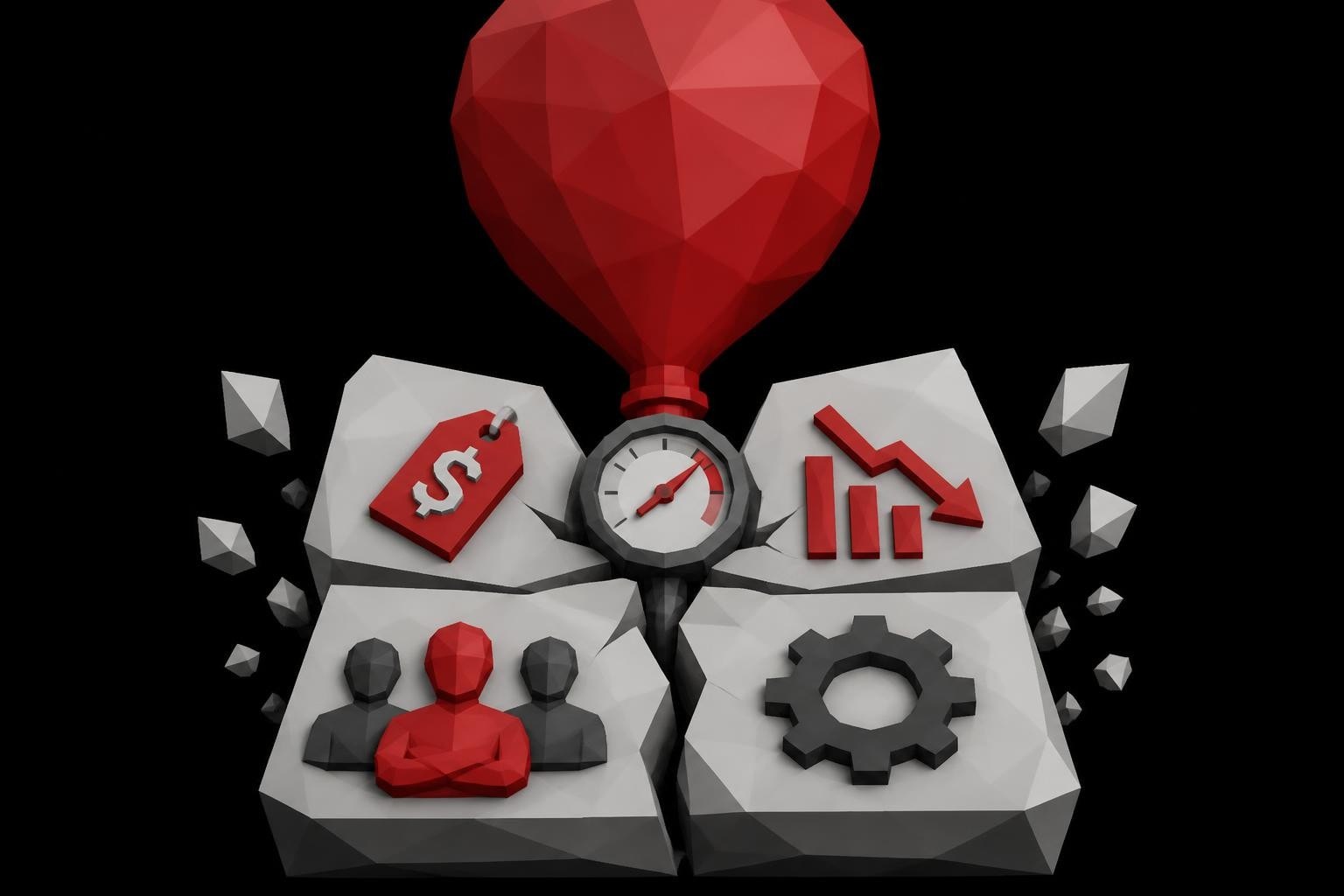
The Trump economy rewards disciplined operators while punishing everyone else. That's not political commentary. It's pattern recognition from watching hundreds of small businesses navigate the exact conditions we're seeing in 2026. Tariff uncertainty, tax policy shifts, and regulatory changes create chaos. Most business owners panic, freeze, or chase shiny objects. The operators with systems, discipline, and execution focus? They're cleaning up. Here's what separates winners from losers when the economic environment gets volatile.
The Economic Reality Most Coaches Won't Tell You
Business leaders at the 2025 World Economic Forum in Davos expressed fascination and concern with Trump’s deal-making approach to economic policy. Translation: nobody knows what's coming next. Policy announcements change weekly. Trade relationships shift overnight. Tax incentives appear and disappear.
This creates two types of business owners.
Type One reads headlines, attends webinars about "navigating uncertainty," and waits for clarity before making decisions. They slow hiring. They delay investment. They justify inaction by pointing to external chaos.
Type Two recognizes that the Trump economy rewards disciplined operators who execute regardless of headlines. They build systems that work in multiple scenarios. They tighten operations. They double down on fundamentals while competitors freeze.
The difference isn't intelligence or capital. It's discipline.
Why Traditional Business Advice Fails Right Now
Most coaching programs and consulting firms peddle the same tired frameworks regardless of economic conditions. They teach "mindset" when you need systems. They sell vision boards when you need operational discipline. They promise transformation when you need execution.
Here's what I've observed working with small business owners across home services, medical practices, financial services, and professional services throughout 2025 and into 2026: the businesses surviving and thriving share three characteristics.
- Brutal operational honesty about what actually generates revenue
- Systems that create consistency regardless of external chaos
- Accountability structures that force execution when motivation fades
Every business that's struggled had the opposite: vague strategies, inconsistent execution, and zero accountability.
The Discipline Advantage in Volatile Markets

When Stanford researchers analyzed tariffs, tax cuts, and economic uncertainties under the Trump administration, they found something crucial: policy uncertainty creates opportunity gaps. Businesses that moved decisively during uncertainty periods captured market share from frozen competitors.
The Trump economy rewards disciplined operators because chaos advantages those with internal control.
Think about your own business right now. When external factors change, do you have systems that tell you exactly what's happening? Do you know your real numbers within 48 hours? Can you adjust pricing, staffing, or operations based on data instead of panic?
Most can't. They're flying blind with quarterly financials and gut feelings.
The Three Pillars of Operational Discipline
| Pillar | What It Means | Why It Matters Now |
|---|---|---|
| Measurement Systems | Real-time visibility into revenue, margins, cash flow | Can't adjust what you can't measure |
| Execution Cadence | Weekly accountability for priorities | Momentum beats perfection in uncertainty |
| Decision Framework | Clear criteria for yes/no choices | Eliminates analysis paralysis |
I've watched HVAC companies, optometry practices, and consulting firms implement these three pillars and immediately create separation from competitors. Not because they're smarter. Because they're disciplined.
One client, a multi-location roofing company, installed weekly revenue reviews and daily lead tracking in Q4 2025. By January 2026, they knew exactly which marketing channels worked, which crews performed, and where margins leaked. When material costs jumped 12% due to tariff announcements, they adjusted pricing within 72 hours while competitors spent weeks "analyzing the situation."
They didn't have better information. They had better discipline.
Why Sales Systems Matter More Than Sales Skills
The conventional wisdom says great salespeople overcome any obstacle. That's partially true and mostly dangerous.
In stable economies, talented salespeople can compensate for terrible systems. When the Trump economy rewards disciplined operators, systems beat talent every time.
Here's what actually happens: your best salesperson leaves, gets sick, or burns out. If your revenue depended on their personal magic, you're done. If you built a system that generates leads, qualifies prospects, follows up consistently, and closes deals through process, you're fine.
The Revenue Generation Audit
We run this audit with every new client. It reveals whether you have a sales system or just sales hope.
Lead Generation:
- Do you know cost per lead by source?
- Can you predict lead volume 30 days out?
- Do leads enter a systematic follow-up process?
Sales Process:
- Is there a documented sales process everyone follows?
- Do you track conversion rates by stage?
- Can any trained person execute the process successfully?
Follow-Up Discipline:
- What percentage of leads get contacted within 24 hours?
- How many touch points happen before marking a lead dead?
- Is follow-up automated or dependent on individual memory?
Most businesses fail at least two of these three categories. Then they wonder why revenue fluctuates wildly.
The Trump economy rewards disciplined operators because systematic revenue generation becomes the only reliable revenue generation. You can't "hustle harder" your way through tariff impacts and policy uncertainty. You need a machine that produces regardless of external conditions.
The Operational Tightness Test

U.S. retailers are currently battling tariff turbulence by tightening supplier relationships and localizing operations. Small businesses need the same operational discipline.
Here's the test: can your business run successfully for two weeks without you?
Not "limp along." Run successfully. Hit revenue targets. Deliver quality work. Serve customers well.
If the answer is no, you don't have a business. You have a job with overhead. And in volatile economic conditions, that job becomes increasingly fragile.
Building Operational Systems That Scale
Most business owners confuse activity with systems. They're busy all day but nothing improves. Real systems have five components:
- Documentation of who does what, when, and how
- Training that transfers knowledge from your head to others
- Delegation with clear ownership and accountability
- Measurement of outcomes, not just effort
- Iteration based on results, not opinions
A mental health group practice owner we worked with had seven therapists and handled all billing, scheduling, and client communication herself. She was working 70-hour weeks and burning out.
We documented every process, hired an operations coordinator, trained them systematically, and delegated with clear metrics. Within 90 days, she worked 35 hours per week and revenue increased 23% because she focused on growth instead of administration.
That's not guru magic. That's operational discipline.
The Truth About Hiring in Uncertain Times
Conventional advice says "hire slow, fire fast." That's incomplete and sometimes backwards.
The Trump economy rewards disciplined operators who build hiring systems that consistently bring in capable people who execute. The companies struggling right now either can't find people or can't keep them. Both problems stem from system failures, not labor market conditions.
The Hiring System Nobody Uses
Here's what works based on actual results across dozens of clients:
Position Definition:
- What outcomes does this role produce? (Not tasks, outcomes)
- What metrics define success in 90 days?
- What character traits matter more than skills?
Attraction Process:
- Where do qualified candidates spend time?
- What messaging addresses their actual concerns?
- How do you differentiate from commodity job posts?
Selection Framework:
- What trial tasks reveal capability before hiring?
- What questions expose work ethic and coachability?
- How do you check references without wasting time?
Onboarding System:
- What must new hires learn in week one, week two, week three?
- Who owns training and accountability?
- What early wins create momentum?
Most businesses skip 75% of this. They post generic job descriptions, interview poorly, hire desperately, and wonder why people don't work out.
One financial advisory firm implemented this framework and reduced time-to-productivity for new advisors from nine months to four months. They didn't find better candidates. They built a better system.
Why Most Businesses Fail the Accountability Test
Everyone talks about accountability. Almost nobody practices it.
Real accountability means agreed-upon outcomes, regular measurement, and honest conversations when results fall short. It's not micromanagement. It's not motivation. It's a system that makes performance visible and unavoidable.
The Trump economy rewards disciplined operators because external chaos exposes internal accountability failures. When everything is smooth, you can hide poor performance. When conditions tighten, weak accountability kills businesses.
Building an Accountability Structure That Works
| Component | What It Includes | Common Failure |
|---|---|---|
| Weekly Reviews | Revenue, margins, priorities, obstacles | Meetings without decisions |
| Clear Metrics | 3-5 numbers that define success | Tracking everything, managing nothing |
| Ownership Assignment | One person owns each priority | Shared responsibility, zero accountability |
| Progress Visibility | Dashboard everyone can see | Numbers hidden in owner's head |
| Consequence Clarity | What happens when commitments aren't met | No follow-through on failures |
An electrical contracting company implemented weekly accountability meetings in November 2025. Every department leader reported three numbers: revenue, margin, and one key priority. If priorities weren't completed, they explained why and what would change.
Within eight weeks, project completion time dropped 18% and margin improved 4.2 percentage points. Same people. Same market. Different accountability.
The Automation Advantage Nobody Discusses
Most articles about automation focus on replacing people or cutting costs. That's the wrong frame.
Smart automation amplifies discipline. It makes consistent execution automatic instead of dependent on daily willpower. And in 2026, with AI tools more accessible than ever, the gap between disciplined operators and everyone else is widening.
Practical Automation for Small Businesses
Here's what actually works based on client implementations:
Lead Response Automation:
- Instant text and email when someone inquires
- Automatic follow-up sequence for non-responders
- Calendar links that eliminate phone tag
Customer Communication:
- Appointment reminders that reduce no-shows
- Post-service follow-up requesting reviews
- Re-engagement campaigns for past customers
Internal Operations:
- Job tracking from estimate to completion
- Automated reporting on key metrics
- Task assignment and deadline reminders
A plumbing company automated their estimate follow-up process. Every estimate automatically got five touch points over 14 days unless the prospect booked or declined. Estimate conversion rate jumped from 28% to 41% without adding salespeople.
That's discipline through automation.
The Financial Discipline Most Owners Lack
Research shows that Trump-era tariffs affect financial market efficiency and small business financial dynamics. Most owners have no idea how policy changes impact their actual numbers because they don't know their actual numbers.
Financial discipline isn't about fancy accounting. It's about knowing three things weekly:
- How much money came in
- How much money went out
- How much you'll have in 30 days

Sounds basic. Most businesses don't do it. They review financials monthly or quarterly, by which time problems are entrenched and opportunities are gone.
The Weekly Financial Review
Every Monday morning, you should know:
- Cash position: Available cash, outstanding receivables, upcoming payables
- Revenue performance: Last week vs. target, month-to-date vs. plan
- Margin reality: Actual margin on completed work, not estimated margin
- Forward indicators: Booked revenue for next 30/60/90 days
This takes 30 minutes if you have systems. It's impossible if you don't.
One optometry practice owner discovered they were losing money on certain insurance plans only after implementing weekly reviews. They'd been "busy" for months without realizing busy didn't mean profitable. They renegotiated contracts and dropped unprofitable plans, increasing net income 31% with slightly lower revenue.
The Trump economy rewards disciplined operators who make decisions based on numbers, not feelings.
Why Contrarian Moves Win Right Now
When everyone zigs, disciplined operators zig with better execution. When everyone zags, disciplined operators stay the course if the data supports it.
Reports indicate Trump’s tariffs harm American manufacturers instead of benefiting them. Most businesses react by cutting everything. Smart operators analyze their specific situation and act accordingly.
If tariffs increase your costs 8% but you've been underpricing by 15%, you fix your pricing and come out ahead. If competitors panic and slash marketing, you maintain yours and capture their market share. If everyone freezes hiring, you recruit talent that wasn't available six months ago.
Contrarian doesn't mean reckless. It means independent analysis and disciplined execution based on your reality, not headlines.
The Contrarian Playbook
Here's what we're seeing work in 2026:
When competitors cut marketing:
- Maintain or increase visibility
- Capture attention at lower cost
- Build brand while others go dark
When everyone panics about costs:
- Audit operations for real waste
- Invest in systems that reduce long-term costs
- Raise prices on underpriced services
When hiring freezes spread:
- Recruit talent from frozen competitors
- Build bench strength for recovery
- Lock in people before competition resumes
A roofing company hired two experienced estimators in Q1 2026 when competitors were cutting staff. They're now booking work 6-8 weeks out while competitors scramble to respond to leads because they're understaffed.
The Trump economy rewards disciplined operators who think independently and execute decisively.
The Real Performance Gap
After working with hundreds of businesses, I can tell you exactly what separates high performers from everyone else. It's not intelligence, capital, connections, or luck.
It's the discipline to do boring things consistently.
Weekly financial reviews. Daily sales activity. Systematic follow-up. Regular one-on-ones with team members. Process documentation. Metrics tracking.
None of this is sexy. All of it works.
The businesses thriving right now aren't doing anything revolutionary. They're executing fundamentals with relentless consistency while competitors chase shortcuts, wait for perfect conditions, or justify inaction.
The Execution Framework That Drives Results
| Element | Frequency | What Success Looks Like |
|---|---|---|
| Financial Review | Weekly | Know exact cash position and trends |
| Sales Activity | Daily | Minimum outbound contacts hit consistently |
| Team Check-ins | Weekly | Every person has clear priorities and support |
| Process Improvement | Monthly | One system documented or upgraded |
| Strategic Planning | Quarterly | Priorities clear, resources allocated |
This framework isn't theoretical. It's what our clients use. The ones who follow it grow. The ones who don't make excuses.
The Investment Mindset Versus Cost Mindset
Experts analyzing how Trump could impact investment portfolios emphasize long-term thinking and strategic positioning. Small business owners need the same approach.
Cost-minded owners ask: "How little can I spend?"
Investment-minded owners ask: "What will generate returns?"
The Trump economy rewards disciplined operators with an investment mindset because strategic spending during uncertainty creates competitive advantages that last years.
Where Smart Operators Invest Right Now
Systems and automation that reduce manual work and increase consistency. ROI shows up in reduced errors, faster processing, and freed time for revenue generation.
Training and development for team members who execute. Better execution means better outcomes, which means better margins.
Marketing that works while competitors cut budgets. Lower competition means better ROI and market share gains.
Strategic hires who can execute independently and free owner time for high-value activities.
Notice what's not on this list: trendy software with unclear ROI, certifications that don't improve performance, coaching programs without accountability, and expensive conferences that generate inspiration instead of results.
The Truth About Business Growth in 2026
Most businesses won't grow in 2026. Not because conditions are difficult, but because most owners lack the discipline to execute consistently regardless of conditions.
The businesses that will grow share these traits:
- Systematic revenue generation that doesn't depend on owner hustle
- Operational discipline that delivers quality consistently
- Financial visibility that enables fast, informed decisions
- Accountability structures that ensure execution
- Strategic thinking that creates advantages while others react
None of this requires genius. All of it requires discipline.
The Trump economy rewards disciplined operators because discipline is the only sustainable competitive advantage. You can't patent it. You can't buy it. You can't hire it if you don't practice it.
You can only build it through consistent execution of boring fundamentals.
What Disciplined Operators Do Next
If you're serious about thriving in current conditions, here's your 30-day action plan:
Week One: Establish Financial Visibility
- Implement weekly cash flow review
- Calculate real margin by service or product line
- Project 90-day cash needs
Week Two: Audit Revenue Systems
- Map current lead generation and conversion process
- Identify gaps in follow-up and nurture
- Measure actual conversion rates
Week Three: Tighten Operations
- Document three critical processes
- Identify one major bottleneck to eliminate
- Assign clear ownership for key activities
Week Four: Build Accountability
- Institute weekly team review meetings
- Define 3-5 key metrics everyone tracks
- Establish consequence framework for missed commitments
This isn't comprehensive. It's foundational. And most business owners won't do it because it requires discipline over motivation.
The ones who do will separate themselves from competitors within 90 days.
The Pattern Nobody Mentions
I've watched this pattern repeat across industries, business models, and market conditions: the businesses that survive economic volatility and policy uncertainty aren't the smartest, best-funded, or best-connected.
They're the most disciplined.
They show up weekly for financial reviews even when busy. They execute sales process even when motivated. They hold people accountable even when uncomfortable. They make decisions based on data even when gut feelings scream otherwise.
The Trump economy rewards disciplined operators because discipline creates predictability in unpredictable times. When you control what you can control with systematic rigor, external chaos becomes manageable noise instead of existential threat.
That's not inspiring. It's true.
And if you want results instead of inspiration, truth matters more than motivation.
The Trump economy rewards disciplined operators who build systems, measure outcomes, and execute consistently regardless of external chaos. Most businesses will struggle in 2026 not because conditions are difficult, but because they lack operational discipline and accountability structures that force execution. If you're tired of making excuses and ready to build real systems that generate predictable results, Accountability Now works with small business owners who want tactical help, honest feedback, and month-to-month coaching without contracts or empty promises.