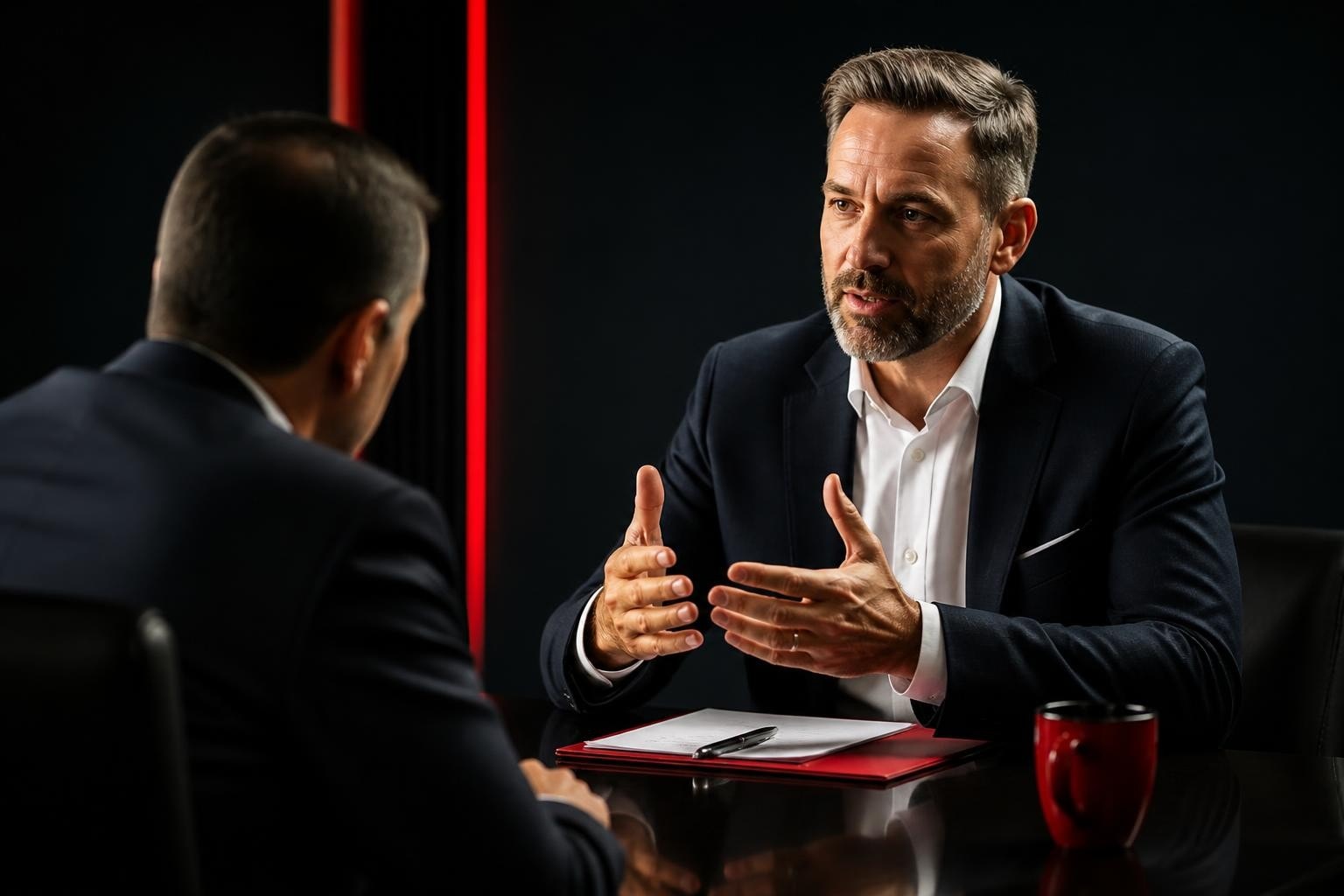
Business owners love to blame external factors when their companies underperform. The economy. Regulations. Tax policy. Market conditions. And now, in 2026, many are pointing to political shifts and hoping that trump policies wont fix poor leadership problems that have existed in their businesses for years. I've watched hundreds of companies rise and fall across three decades. The pattern is clear: external policy changes don't fix internal execution failures. Your business problems aren't political. They're operational, cultural, and personal.
The Political Excuse Trap Killing Small Businesses
Most struggling business owners I meet are waiting for something external to change their fortunes. A new administration. Better regulations. Lower taxes. More favorable trade policies.
It's a comforting narrative. If the problem is outside your control, you're not responsible for fixing it.
But here's what I've learned after building multiple eight-figure companies and coaching hundreds of business owners: external conditions matter far less than internal execution. The businesses that succeed do so regardless of who sits in the White House. The ones that fail do so for the same reason every time: poor leadership, weak systems, and zero accountability.
Why Owners Reach for Political Explanations
When your sales pipeline is dry, it's easier to blame policy uncertainty than admit you haven't made 50 outbound calls in six months. When employee turnover is high, pointing to labor regulations feels better than confronting your lack of training systems or accountability structures.
I saw this pattern repeat during every administration change since the 1990s. Owners convince themselves the next policy shift will unlock growth. It rarely does.
According to Gallup’s assessment of leadership qualities, public perceptions of political leadership often focus on personality traits rather than execution capabilities. Business owners fall into the same trap, fixating on high-level policy debates while ignoring the daily leadership failures destroying their profit margins.

What Trump Policies Actually Changed (And What They Didn't)
Let's be specific about what policy shifts have and haven't accomplished for small businesses. I'm not making a political argument. I'm making an operational one based on what I've observed across hundreds of clients.
Tax Policy Changes:
- Corporate tax rates dropped from 35% to 21% in 2017
- Pass-through deductions benefited many small businesses
- These changes put more cash in owner pockets
What didn't change:
- Poor cash flow management
- Lack of financial visibility
- Inability to price services profitably
- Weak collection systems
I had clients who saved $40,000 in taxes but still couldn't tell me their cost per acquisition or lifetime customer value. The tax savings got absorbed into operational chaos instead of reinvested strategically.
Regulatory Rollbacks:
- Some compliance burdens decreased
- Certain industries saw reduced oversight
- Administrative costs dropped for specific sectors
What didn't change:
- Inconsistent quality control
- Lack of standard operating procedures
- Poor documentation habits
- Reactive instead of proactive management
The Brookings Institution noted that Trump represented conventional Republican policy but with notable incompetence in execution. The same applies to business owners who focus on policy while executing poorly. You can have favorable conditions and still fail spectacularly.
The Numbers Don't Lie About Leadership Impact
| Factor | Impact on Business Success | Under Your Control |
|---|---|---|
| Tax policy changes | 5-15% financial benefit | No |
| Interest rate environment | Moderate financing impact | No |
| Regulatory burden | Variable by industry | Partly |
| Leadership execution | 60-80% of outcomes | Yes |
| Systems and processes | 50-70% of efficiency | Yes |
| Team accountability | 40-60% of productivity | Yes |
Notice where the real leverage sits. The factors you control directly outweigh everything else combined.
The Real Leadership Gaps Destroying Businesses Right Now
After conducting over 1,200 business audits between 2020 and 2026, I've identified the recurring leadership failures that no policy change will ever fix. These patterns appear across every industry I work with: home services, medical practices, financial services, and professional consulting.
Gap One: No Clear Decision-Making Framework
Most owners make decisions based on feelings, urgency, or whoever yelled loudest in the last meeting. They lack a systematic approach to evaluating opportunities, allocating resources, or saying no.
Real Example:
A roofing company owner in Texas blamed economic uncertainty for declining margins in 2024. When I audited his operation, he had:
- Taken on 14 unprofitable jobs in Q1 because "we needed the revenue"
- Failed to raise prices in 18 months despite material cost increases of 23%
- Never calculated job profitability until 30 days after completion
- Made hiring decisions without any objective criteria
His leadership problem wasn't policy. It was the absence of any decision framework whatsoever.
Gap Two: Zero Accountability Infrastructure
You can't blame political conditions for not holding people accountable. Yet most businesses operate without:
- Clear performance metrics
- Regular review cadences
- Documented expectations
- Consequences for missed targets
- Rewards for exceptional performance
I've watched this play out hundreds of times. An owner complains about team performance while running their business on gut feel and hope. When I ask what metrics they track, I get blank stares.
The Accountability Audit Results (326 businesses, 2024-2025):
- 78% had no written job descriptions
- 83% conducted performance reviews annually or never
- 91% had no documented KPIs for sales roles
- 67% couldn't name their top performer by any objective measure
- 94% had never terminated someone for sustained underperformance
These failures have nothing to do with Washington and everything to do with leadership weakness.
Gap Three: Systems Built on Heroism Instead of Process
The third fatal gap is building a business that requires constant heroic effort instead of repeatable systems. This is where trump policies wont fix poor leadership becomes most obvious.
Owners tell me they need better economic conditions, when what they really need is:
- A documented sales process that converts leads consistently
- Standard operating procedures for core services
- A hiring system that finds qualified candidates
- Training protocols that get new hires productive quickly
- Financial dashboards that surface problems before they become crises
Analysis from Fletcher School at Tufts examining leadership maturity reveals how leadership style impacts organizational effectiveness. Immature leadership creates chaos regardless of favorable external conditions. I see the same pattern in businesses where owners confuse activity with accomplishment and heroism with leadership.

The Execution Gap: Why Good Conditions Don't Guarantee Good Results
I've coached businesses through boom times and recessions, favorable policy environments and hostile ones. The execution gap explains more variance in outcomes than any external factor.
Case Study: Two HVAC Companies, Same Market, Different Outcomes
Company A (Annual Revenue: $3.2M in 2025):
- Blamed inflation and labor shortages for stagnant growth
- Waited for "conditions to improve" before investing in systems
- Owner worked 65 hours weekly doing technical work
- No sales process beyond answering phones
- Hired based on "gut feel"
- Profitability: 6%
Company B (Annual Revenue: $8.1M in 2025, up from $4.7M in 2023):
- Built documented sales process in Q1 2024
- Implemented weekly pipeline reviews
- Created hiring scorecard and structured interviews
- Trained three sales reps using repeatable methodology
- Tracked 12 operational KPIs monthly
- Profitability: 18%
Same city. Same economic conditions. Same regulations. Same labor market. Radically different results driven entirely by leadership execution.
The owner of Company B didn't wait for policy changes. He fixed his leadership gaps.
The Performance Multiplication Effect
Strong leadership doesn't just add value. It multiplies it. Here's what I've observed across client engagements:
Weak Leadership + Favorable Conditions = Marginal Improvement
When economic tailwinds help a poorly-led business, the gains are temporary. The owner attributes success to external factors, learns nothing, and gets crushed when conditions normalize.
Strong Leadership + Challenging Conditions = Sustained Growth
The best-led businesses in my portfolio grew through 2022-2023 despite inflation, labor shortages, and economic uncertainty. They executed better than competitors and captured market share.
Strong Leadership + Favorable Conditions = Exponential Results
This is where magic happens. When a well-led business with tight systems catches a favorable wind, growth accelerates dramatically.
The variable isn't the condition. It's the leadership.
What Most Business Coaches Get Wrong About External Factors
The coaching industry loves to minimize external challenges. "Just execute better!" they say, while ignoring real market dynamics. That's equally stupid as blaming everything on politics.
Here's the nuanced truth: External factors matter, but only after you've maximized what you control.
The Proper Order of Operations
- Fix your leadership first – decision frameworks, accountability, personal discipline
- Build systems second – sales process, operations, hiring, finance
- Optimize for environment third – tax strategy, regulatory compliance, market positioning
Most owners reverse this order. They obsess over policy while their operations bleed cash.
I recently worked with a financial advisor who spent hours weekly reading economic commentary and adjusting investment theses based on potential policy changes. Meanwhile, his practice had:
- No systematic client acquisition process
- No referral system despite 200+ satisfied clients
- No service tier structure
- No documented workflows for onboarding
His intellectual understanding of policy was impressive. His business execution was amateur hour.
Research from the Brennan Center documenting how leadership failures hindered pandemic response shows what happens when organizations lack qualified leadership and accountability structures. Policy becomes irrelevant when execution capacity doesn't exist.

The Accountability Framework That Actually Works
After decades of building and coaching businesses, I've developed a simple framework for identifying where leadership attention should focus. It's not sexy. It's not a political debate. It works.
The Four Pillars of Leadership Execution
Pillar 1: Clarity
Do you have crystal-clear answers to these questions?
- What exactly are we trying to accomplish in the next 90 days?
- Who is responsible for each key result?
- What does success look like, measured objectively?
- What are we explicitly choosing NOT to do?
Most owners can't answer these without hemming and hawing. That's a leadership problem, not a policy problem.
Pillar 2: Capability
Do your people actually know how to do what you're asking?
- Have they been trained with a documented process?
- Do they have the tools and resources required?
- Have you verified they can execute before expecting results?
- Do you have a systematic way to develop skills?
I can't count how many owners blame underperformance when they've never actually trained anyone on expectations.
Pillar 3: Consequences
Does performance actually matter in your business?
- Do people experience negative consequences for sustained underperformance?
- Do high performers get rewarded in meaningful ways?
- Are standards enforced consistently?
- Do you follow through on what you say?
The businesses with the worst performance have owners who make empty threats and ignore standards violations. Your team watches what you tolerate, not what you say.
Pillar 4: Consistency
Are your leadership behaviors predictable and reliable?
- Do you run the same meeting cadence weekly?
- Do you review the same metrics on schedule?
- Do you apply the same standards to everyone?
- Do you maintain your commitments to the team?
Inconsistent leadership creates chaos regardless of market conditions. Your team can adapt to tough standards. They can't adapt to random ones.
The Trump Policies Won't Fix Poor Leadership Litmus Test
Here's my simple diagnostic for whether you're dealing with a leadership problem or a policy problem:
| Question | Leadership Problem | Policy Problem |
|---|---|---|
| If conditions improved tomorrow, would results change significantly? | No | Yes |
| Can you point to specific execution failures in the last 30 days? | Yes | No |
| Do you track objective performance metrics weekly? | No | Yes |
| Could a more disciplined competitor beat you in this market? | Yes | No |
| Have you built and refined core processes? | No | Yes |
If you scored mostly in the left column, stop reading economic commentary. Start fixing your leadership.
Building a Business That Wins Regardless of Policy
The businesses that dominate their markets do so because they've built execution engines that generate results in any environment. They don't wait for favorable conditions. They create them.
The System-First Approach
Sales System:
- Documented process from first contact to close
- Conversion metrics tracked by stage
- Regular pipeline reviews with accountability
- Training protocol for new sellers
- Objection handling library built from real scenarios
When you have this, policy changes create opportunities for optimization. When you don't, policy changes create excuses.
Operations System:
- Standard operating procedures for core deliverables
- Quality control checkpoints
- Efficiency metrics tracked over time
- Continuous improvement process
- Escalation paths for exceptions
I've seen home service companies double their capacity without adding trucks simply by documenting and optimizing their processes. No policy change required.
People System:
- Structured hiring process with objective criteria
- Onboarding checklist and training timeline
- Clear performance expectations and review cadence
- Development plans for A-players
- Performance improvement protocols for underperformers
The companies with these systems attract better talent and get better results regardless of labor market conditions.
Financial System:
- Weekly cash position visibility
- Monthly P&L review with variance analysis
- Job or client profitability tracking
- Leading indicator dashboard
- Scenario planning for decisions
When you have financial clarity, you can respond strategically to policy changes. When you're flying blind, you just react emotionally.
Real Results from Leadership-First Businesses
These outcomes come from businesses that fixed leadership before worrying about policy:
Medical Practice (Optometry):
- Problem: Blamed insurance reimbursement rates for declining profitability
- Diagnosis: No patient flow system, irregular billing follow-up, zero cross-sell process
- Solution: Built standardized patient journey, implemented weekly billing reviews, trained staff on frame sales
- Result: Revenue up 34% in 11 months, profit margin improved from 12% to 21%
- Lesson: Insurance rates didn't change. Execution did.
Plumbing Company:
- Problem: Attributed revenue plateau to market saturation and competition
- Diagnosis: No lead follow-up system, quote conversion rate of 31%, no customer database strategy
- Solution: Implemented CRM with automated follow-up, trained on consultative selling, built maintenance agreement program
- Result: Conversion rate increased to 58%, maintenance contracts generated $180K annual recurring revenue
- Lesson: Market didn't change. Leadership commitment to systems did.
Financial Advisory Firm:
- Problem: Blamed market volatility for difficulty attracting new clients
- Diagnosis: No systematic referral process, no content marketing, reactive outbound efforts
- Solution: Created referral request protocol, launched weekly market commentary, implemented structured networking plan
- Result: Client acquisition increased 180% year-over-year, average account size up 40%
- Lesson: Markets are always volatile. Process discipline isn't.
Each of these businesses had access to the same political and economic conditions as their competitors. The difference was leadership execution.
The Contrarian View: Why Difficult Conditions Build Better Businesses
Here's something most coaches won't tell you: favorable policy conditions often create weak businesses. When everything is easy, owners develop sloppy habits. They get away with poor systems because rising tides lift all boats.
I've watched this repeatedly. The businesses built during challenging periods develop discipline, efficiency, and resilience that easy-money competitors never acquire.
What I've Observed Across Economic Cycles
Built During Easy Times (2004-2007, 2012-2019):
- Higher overhead ratios
- Less pricing discipline
- Weaker hiring standards
- Minimal financial controls
- Over-reliance on external growth factors
Many of these businesses collapsed during downturns because they never developed operational muscle.
Built During Hard Times (2008-2011, 2020-2021):
- Lean operations from day one
- Strong unit economics
- Rigorous hiring and training
- Tight financial management
- Focus on fundamentals over hype
These businesses often dominated their markets when conditions improved because they maintained the discipline that created their success.
Studies examining how leadership traits shape policy decisions reveal that personality and belief systems drive outcomes more than external circumstances. The same applies in business. Your leadership traits determine your response to conditions, and that response determines your results.
What to Do Instead of Waiting for Policy Changes
Stop reading economic forecasts. Start executing on what you control.
This Week:
- Write down your top 3 business goals for the next 90 days – Be specific and measurable
- Identify the single biggest bottleneck preventing achievement – Name it clearly
- Assign one person direct responsibility for fixing it – With a deadline
- Schedule weekly 30-minute reviews – To track progress and adjust
This Month:
- Document your core sales process from lead to close
- Create a hiring scorecard for your most important role
- Implement weekly team accountability meetings
- Build a financial dashboard you review every Monday
This Quarter:
- Audit your top 10 operational processes and document them
- Create training protocols for all critical roles
- Implement objective performance metrics for every position
- Build a 12-month strategic plan with quarterly milestones
None of this requires favorable policy. All of it requires leadership discipline.
The Questions That Reveal Your Real Priorities
Answer these honestly:
- How many hours did you spend last week reading political news versus building operational systems?
- When did you last update your sales process documentation?
- Can you name your top performer in each department and explain why with data?
- What percentage of your team could execute their core job if you disappeared for 30 days?
Your answers reveal whether you're serious about leadership or just looking for excuses.
The Truth About Trump Policies and Business Success
Let me be direct about something the coaching industry dances around: trump policies wont fix poor leadership because no external factor can substitute for internal discipline. This isn't political. It's mathematical.
Your business results are a function of the decisions you make daily, the systems you build, the people you develop, and the standards you enforce. Policy changes can make these efforts 10-15% easier or harder. Leadership execution determines the other 85-90%.
Analysis from Harvard Kennedy School examining government efficiency initiatives shows that sweeping policy changes create temporary disruption but don't fundamentally alter organizational effectiveness. What matters is leadership capacity to execute within whatever environment exists.
The Ownership Mindset Shift
Here's what separates businesses that grow from those that stagnate:
Victim Mindset:
- External factors determine my success
- I'm waiting for conditions to improve
- My problems are everyone else's fault
- I can't win until things change
Owner Mindset:
- I control my response to any environment
- I'm building systems regardless of conditions
- My results reflect my execution quality
- I win by outworking and outsysteming competitors
The companies I've built and sold succeeded because we operated from the second mindset. The clients who get the best results make this same shift.
You can complain about policy or you can build a dominant business. Pick one.
Building Your Anti-Fragile Business
The businesses that thrive across decades don't just survive policy changes. They get stronger from them. This is what Nassim Taleb calls anti-fragility: gaining from disorder.
The Components of an Anti-Fragile Business
Financial Anti-Fragility:
- Low fixed costs relative to revenue
- Multiple revenue streams
- Strong cash reserves (6+ months operating expenses)
- Flexible cost structure
- No dependence on single customers or channels
Operational Anti-Fragility:
- Documented processes that don't require specific people
- Cross-trained team members
- Automation where appropriate
- Redundancy in critical systems
- Regular stress-testing of operations
Strategic Anti-Fragility:
- Diversified customer base
- Multiple market positioning options
- Ability to pivot quickly based on data
- Regular scenario planning
- Strong relationships with multiple stakeholder groups
When you build these capabilities, policy changes create opportunities instead of threats. You can respond strategically while competitors panic.
The 2026 Reality Check
As we move through 2026, business owners face continued uncertainty around trade policy, regulatory frameworks, tax structures, and economic conditions. None of that matters as much as whether you've built a disciplined, accountable organization.
The owners winning right now aren't the ones with the best political connections or policy predictions. They're the ones who:
- Make 50+ sales outreaches weekly regardless of market sentiment
- Review financial metrics every Monday morning without exception
- Hold team members accountable to objective standards consistently
- Invest in systems even when revenue is tight
- Make difficult decisions quickly based on data
That's leadership. Everything else is commentary.
Leadership execution separates winning businesses from failing ones, regardless of political conditions. The owners who stop waiting for external changes and start fixing internal systems will dominate their markets in 2026 and beyond. If you're ready to build real accountability, operational discipline, and sustainable growth, Accountability Now provides the direct, no-nonsense coaching that actually moves the needle. We don't do contracts, we don't sell hype, and we only work with owners serious about execution.